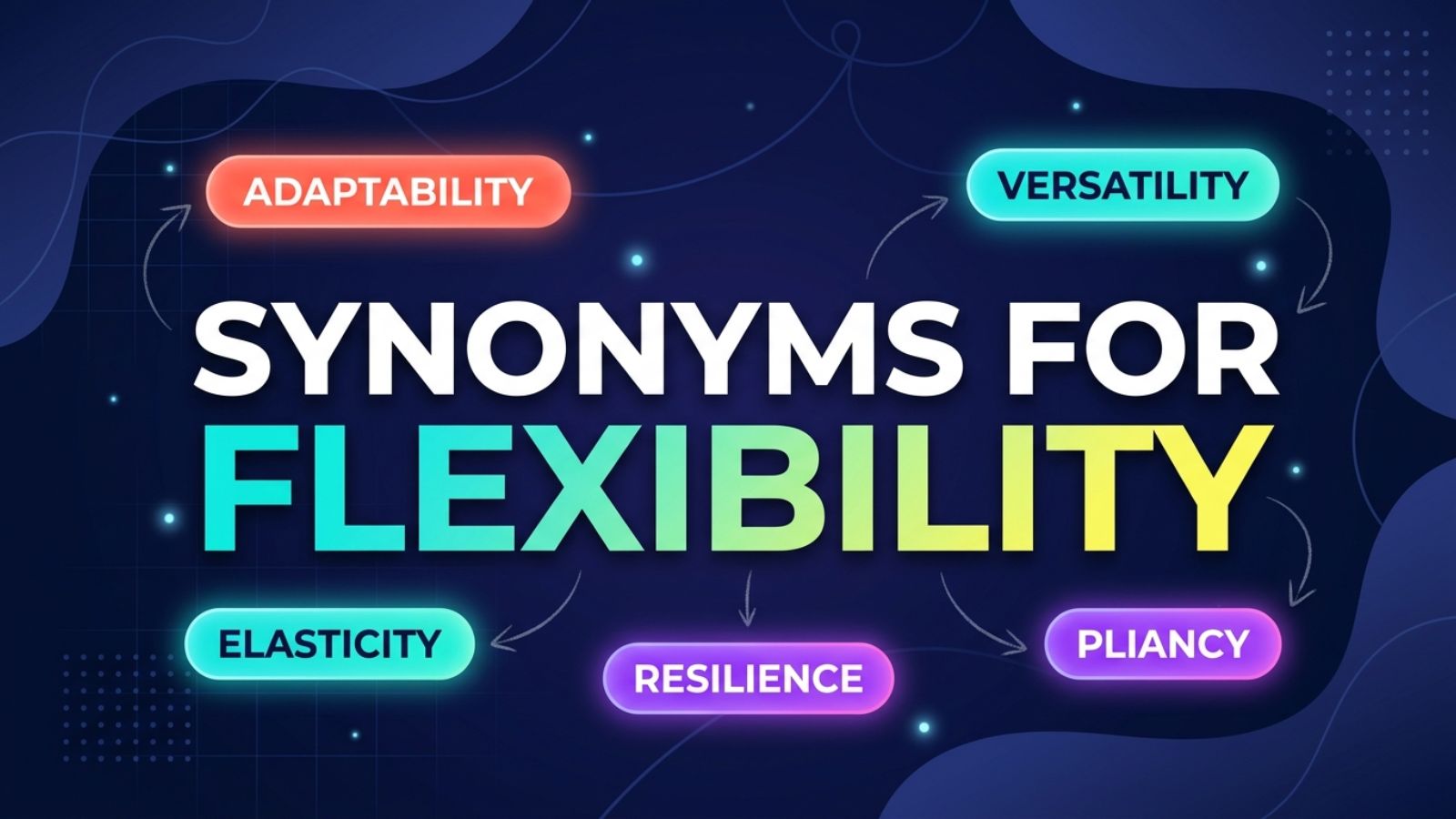
Flexibility means the ability to adapt to changes, adjust to different situations, or bend without breaking. However, the best synonyms for flexibility depend on what you want to express. In professional writing, adaptability or versatility may be more appropriate, while elasticity often describes physical materials and open-mindedness refers to a willingness to consider different ideas.
Whether you are writing an academic essay, improving your vocabulary, updating a résumé, or looking for a more precise word, understanding these alternatives can make your writing clearer and more effective. This guide explains useful synonyms for flexibility, their meanings, example sentences, and the contexts in which each word works best.
What Does Flexibility Mean?
Flexibility is the ability to change, adapt, or adjust according to circumstances, needs, or requirements. It can describe a person’s behavior, a work arrangement, a physical object, or a system that accommodates different situations.
Flexibility is a noun. Its meaning changes slightly depending on the context.
- Personal flexibility: The ability to adjust to new circumstances or different viewpoints.
- Professional flexibility: The ability to handle changing responsibilities, schedules, or working conditions.
- Physical flexibility: The ability of a body or material to bend or move without breaking.
- Mental flexibility: The ability to consider alternative ideas and change one’s approach.
- Organizational flexibility: The ability of a business or system to respond to changing needs.
Examples:
- Her flexibility helped her adjust quickly to the new school environment.
- The company offers flexibility in working hours.
- Regular stretching can improve physical flexibility.
- Good leaders demonstrate flexibility when plans change.
Best Synonyms for Flexibility
The following words are useful alternatives, but they are not interchangeable in every sentence. Choose the one that communicates your intended meaning most accurately.
1. Adaptability
Meaning: The ability to adjust successfully to new conditions, challenges, or environments.
Adaptability is one of the closest synonyms for flexibility when describing people, teams, and organizations.
Example: Her adaptability helped her succeed in a rapidly changing workplace.
2. Versatility
Meaning: The ability to perform different tasks or serve several purposes effectively.
Use versatility when someone or something can handle a wide range of responsibilities.
Example: The versatility of this software makes it useful for different projects.
3. Adjustability
Meaning: The ability to be changed or modified to meet different needs.
This word is particularly useful for equipment, settings, systems, and arrangements.
Example: The chair’s adjustability allows users to find a comfortable position.
4. Elasticity
Meaning: The ability to stretch or change shape and return toward the original form, or the capacity to respond to changing conditions in certain technical contexts.
Elasticity is especially appropriate for materials, economics, and scientific discussions.
Example: The elasticity of the rubber band allows it to stretch without permanently changing shape.
5. Open-mindedness
Meaning: A willingness to consider different opinions, ideas, or perspectives.
Use this alternative when flexibility refers to someone’s thinking rather than their schedule or physical movement.
Example: Her open-mindedness helped the team find a better solution.
6. Malleability
Meaning: The ability to be shaped, molded, or influenced.
Malleability commonly describes materials, although it can also describe a person’s ideas or attitudes.
Example: The malleability of the metal makes it suitable for detailed designs.
7. Plasticity
Meaning: The ability to change shape or structure, often without immediately returning to the original form.
This is a more technical alternative used in materials science, biology, and neuroscience.
Example: The plasticity of the material makes it useful in manufacturing.
8. Fluidity
Meaning: The quality of changing, moving, or developing smoothly without rigid restrictions.
Fluidity is useful when describing processes, communication, movement, or changing arrangements.
Example: The fluidity of the schedule allowed the team to accommodate unexpected requests.
9. Responsiveness
Meaning: The ability or willingness to react quickly and appropriately to changes, requests, or needs.
Responsiveness emphasizes reaction rather than the broader ability to adapt.
Example: The manager’s responsiveness helped resolve customer concerns quickly.
10. Agility
Meaning: The ability to move, think, or respond quickly and effectively.
Agility is particularly useful in business, technology, sports, and problem-solving contexts.
Example: The team’s agility allowed it to respond to changing customer expectations.
11. Open-mindedness and Adaptability in Comparison
Although both words relate to flexibility, they emphasize different qualities. Open-mindedness involves considering new ideas, while adaptability involves adjusting to circumstances. A person can be open-minded without necessarily changing their behavior.
Formal Synonyms for Flexibility
Formal alternatives are useful in academic assignments, business reports, professional emails, and research writing.
| Synonym | Meaning or context | Example |
|---|---|---|
| Adaptability | Adjusting to changing circumstances | Adaptability is essential during organizational change. |
| Versatility | Handling multiple tasks or functions | The candidate demonstrated versatility across several departments. |
| Elasticity | Capacity to stretch or respond to change in technical contexts | Price elasticity influences consumer demand. |
| Modifiability | The capacity to be modified | The system’s modifiability supports future improvements. |
| Resilience | Recovering or functioning effectively after difficulties | The team’s resilience helped it manage unexpected setbacks. |
| Accommodating nature | Willingness to meet reasonable needs | Her accommodating nature made collaboration easier. |
| Maneuverability | Ease of movement or ability to navigate situations | The vehicle’s maneuverability makes parking easier. |
| Tolerance | The ability to withstand variation or differences | The equipment has a high tolerance for temperature changes. |
Important distinction: Resilience focuses on withstanding or recovering from difficulties, whereas flexibility focuses on adjusting or changing. Similarly, tolerance refers to the capacity to withstand variation, not necessarily a willingness to adapt.
Synonyms for Flexibility in the Workplace
When describing professional skills, the best alternative depends on whether you mean adapting to change, performing multiple tasks, or accommodating different needs.
- Adaptability: Adjusting to new responsibilities, procedures, or work environments.
- Versatility: Performing different roles or handling varied assignments.
- Agility: Responding quickly to changing priorities.
- Responsiveness: Reacting appropriately to requests or emerging problems.
- Openness: Being willing to consider feedback and alternative approaches.
- Resourcefulness: Finding practical ways to solve problems with available resources.
- Cooperation: Working effectively with others, especially when plans need to change.
- Willingness to compromise: Finding a mutually acceptable solution when preferences differ.
Examples in professional writing:
- Original: The employee showed flexibility when project requirements changed.
- Alternative: The employee demonstrated adaptability when project requirements changed.
- Original: We need flexibility to manage multiple responsibilities.
- Alternative: We need versatility to manage multiple responsibilities.
- Original: The department values flexibility when responding to customer needs.
- Alternative: The department values responsiveness when addressing customer needs.
For a résumé, adaptability, versatility, and agility are often effective choices because they communicate specific professional strengths. Use them only when they accurately describe your abilities.
Synonyms for Flexibility in Different Contexts
1. Flexibility in Thinking
When describing someone’s ability to consider new perspectives, these alternatives may be appropriate:
- Open-mindedness: Willingness to consider different opinions.
- Mental agility: Ability to think quickly and adjust reasoning.
- Adaptability: Ability to change one’s approach when needed.
- Receptiveness: Willingness to listen to or consider new ideas.
- Versatility: Ability to approach different kinds of tasks or problems.
Example: The teacher encouraged open-mindedness during classroom discussions.
2. Flexibility in Scheduling
When referring to appointments, deadlines, or working hours, consider:
- Adjustability: The ability to modify arrangements.
- Freedom: The ability to choose when or how something happens.
- Latitude: Room for personal judgment or decision-making.
- Accommodation: An adjustment made to meet particular needs.
- Convenience: The quality of being suitable or easy to arrange.
Example: The employer offers flexibility in scheduling to accommodate students’ classes.
In this context, latitude is especially useful when someone has discretion over decisions, while accommodation emphasizes making an adjustment for a particular need.
3. Physical Flexibility
When discussing the body, exercise, or materials, the appropriate vocabulary includes:
- Bendability: The ability to bend.
- Elasticity: The ability to stretch and return toward an original shape.
- Suppleness: The quality of being easily bent or moved.
- ** pliability:** The ability to bend or be shaped without breaking.
- Resilience: The ability to recover after deformation or strain, depending on the material and context.
Example: Yoga can help improve the suppleness and range of motion of the body.
These words have different technical meanings. In exercise, mobility refers to the ability to move a joint or body part through its available range of motion, so it is related to flexibility but not identical to it.
4. Flexibility in Rules and Policies
When discussing rules, procedures, or agreements, consider:
- Leniency: A tendency to be less strict or severe.
- Discretion: The freedom to make decisions within certain limits.
- Latitude: Room to exercise judgment.
- Adaptability: The ability to change in response to circumstances.
- Permissiveness: A willingness to allow behavior or choices that might otherwise be restricted.
Example: The teacher showed leniency when granting an extension for a genuine emergency.
Leniency and permissiveness can suggest reduced strictness, so they are not neutral replacements for flexibility in every context.
Positive and Negative Connotations of Flexibility
Flexibility usually has a positive meaning, particularly when it describes cooperation, problem-solving, and adaptation. However, some related words carry different implications.
| Word | Connotation | Typical use |
|---|---|---|
| Adaptability | Positive or neutral | Adjusting successfully to change |
| Versatility | Positive | Handling different tasks well |
| Open-mindedness | Positive | Considering other perspectives |
| Leniency | Context-dependent | Being less strict |
| Permissiveness | Sometimes negative | Allowing too much freedom |
| Indecisiveness | Negative | Struggling to make decisions |
| Inconsistency | Often negative | Failing to maintain a reliable pattern |
| Compromise | Neutral or positive | Reaching a middle ground |
For example, flexibility in leadership can be a strength because it helps a manager respond to new information. However, changing decisions without a clear reason may appear inconsistent.
Remember: Flexibility does not mean abandoning standards or agreeing with everyone. Effective flexibility involves adjusting appropriately while maintaining important principles.
Flexibility Synonyms: Quick Comparison
Use this table to identify the best word for your intended meaning.
| If you mean… | Best alternative |
|---|---|
| Adjusting to new situations | Adaptability |
| Performing many different tasks | Versatility |
| Changing settings or arrangements | Adjustability |
| Considering different opinions | Open-mindedness |
| Responding quickly to change | Agility |
| Reacting to requests or needs | Responsiveness |
| Bending or stretching physically | Elasticity |
| Being easily shaped | Malleability |
| Having freedom to make decisions | Latitude |
| Being less strict | Leniency |
| Recovering after difficulties | Resilience |
| Finding solutions creatively | Resourcefulness |
What Is the Difference Between Flexibility and Adaptability?
Flexibility is the general ability to adjust, bend, or accommodate different needs. Adaptability specifically emphasizes the ability to adjust successfully to new conditions.
For example:
- Flexibility: The manager showed flexibility by allowing employees to adjust their working hours.
- Adaptability: The manager showed adaptability by learning a new management system.
The first sentence focuses on accommodating different arrangements. The second emphasizes adjusting to a change.
The two words overlap considerably, especially when describing people and organizations. However, adaptability is often the more precise choice when the main idea is responding to changing circumstances.
What Is the Opposite of Flexibility?
The opposite of flexibility depends on the context. Several words describe rigidity, resistance to change, or an inability to adapt.
- Rigidity: Inability or unwillingness to bend or change.
- Inflexibility: Lack of flexibility or unwillingness to adjust.
- Stiffness: Lack of ease in bending or movement.
- Strictness: Firm adherence to rules or standards.
- Resistance: Opposition to change or influence.
- Intransigence: Refusal to compromise or change one’s position.
- Fixedness: The state of being fixed or unchanging.
Examples:
- The policy’s rigidity made it difficult to accommodate unusual circumstances.
- His inflexibility prevented the team from considering alternative solutions.
- The material’s stiffness made it unsuitable for the intended design.
Rigidity and inflexibility are the closest general opposites. Stiffness is more suitable for physical movement or materials, while intransigence describes a firm refusal to compromise.
Common Mistakes When Using Synonyms for Flexibility
Choosing a related word without checking its precise meaning can make a sentence confusing. Avoid these common mistakes.
1. Using versatility when you mean adaptability
Versatility emphasizes performing different tasks, while adaptability emphasizes adjusting to new conditions.
- Less precise: Her versatility helped her adjust to an unfamiliar culture.
- More precise: Her adaptability helped her adjust to an unfamiliar culture.
The first sentence is not necessarily wrong, but the second expresses adjustment more directly.
2. Confusing flexibility with resilience
Resilience involves recovering or continuing to function after difficulties. Flexibility involves adjusting to circumstances.
Example: A resilient team recovers after a setback, while a flexible team changes its strategy when conditions shift.
A team can demonstrate both qualities.
3. Using elasticity for every type of flexibility
Elasticity is especially suitable for physical materials and technical concepts such as economic responsiveness. It usually sounds unnatural when describing ordinary interpersonal flexibility.
Instead of saying, “Her elasticity helped her manage a changing schedule,” write, “Her adaptability helped her manage a changing schedule.”
4. Treating flexibility as a lack of principles
Flexibility does not automatically mean being weak, indecisive, or willing to accept every request. A person can adjust their approach while remaining consistent about important values.
Example: The manager remained flexible about deadlines but maintained the company’s safety requirements.
Frequently Asked Questions
1. What is the best synonym for flexibility?
Adaptability is one of the best general synonyms when flexibility means adjusting to changing circumstances. However, versatility is more appropriate for performing different tasks, while elasticity is suitable for physical materials.
2. What are five synonyms for flexibility?
Five useful synonyms are adaptability, versatility, adjustability, elasticity, and agility. Each has a slightly different meaning, so the best choice depends on whether you are discussing personal behavior, work, physical properties, or responsiveness to change.
3. What is a formal word for flexibility?
Adaptability, versatility, modifiability, and elasticity can serve as formal alternatives in appropriate contexts. For academic or professional writing about personal skills, adaptability is often a particularly effective choice.
4. What is another word for flexibility on a résumé?
Adaptability, versatility, and agility are useful résumé alternatives. For example, you could write, “Demonstrated adaptability when managing changing project requirements.” Choose a term that accurately represents your experience.
5. What is the opposite of flexibility?
The closest general opposites are inflexibility and rigidity. Stiffness usually refers to physical movement or materials, while intransigence describes an unwillingness to compromise or change one’s position.
6. Is adaptability the same as flexibility?
The words are closely related but not identical. Flexibility describes the broader ability to adjust or accommodate, while adaptability emphasizes adjusting successfully to new circumstances. In many everyday sentences, either word may work.
Conclusion
The best synonyms for flexibility depend on the meaning you want to communicate. Adaptability works well for adjusting to change, versatility describes the ability to perform different tasks, agility emphasizes quick responses, and elasticity suits physical or technical contexts. Other alternatives, such as open-mindedness, adjustability, and latitude, express more specific aspects of flexibility.
When choosing a synonym, consider the subject, tone, and purpose of your sentence. Selecting a precise word will make your academic writing, professional communication, and everyday English clearer and more natural.