Have you ever received a message containing IGN and wondered what the person was trying to say? Internet slang can sometimes be confusing, especially when someone uses short abbreviations without explaining them.
If you have seen IGN in a text message, gaming conversation, social media comment, or online chat, you might be curious about its meaning.
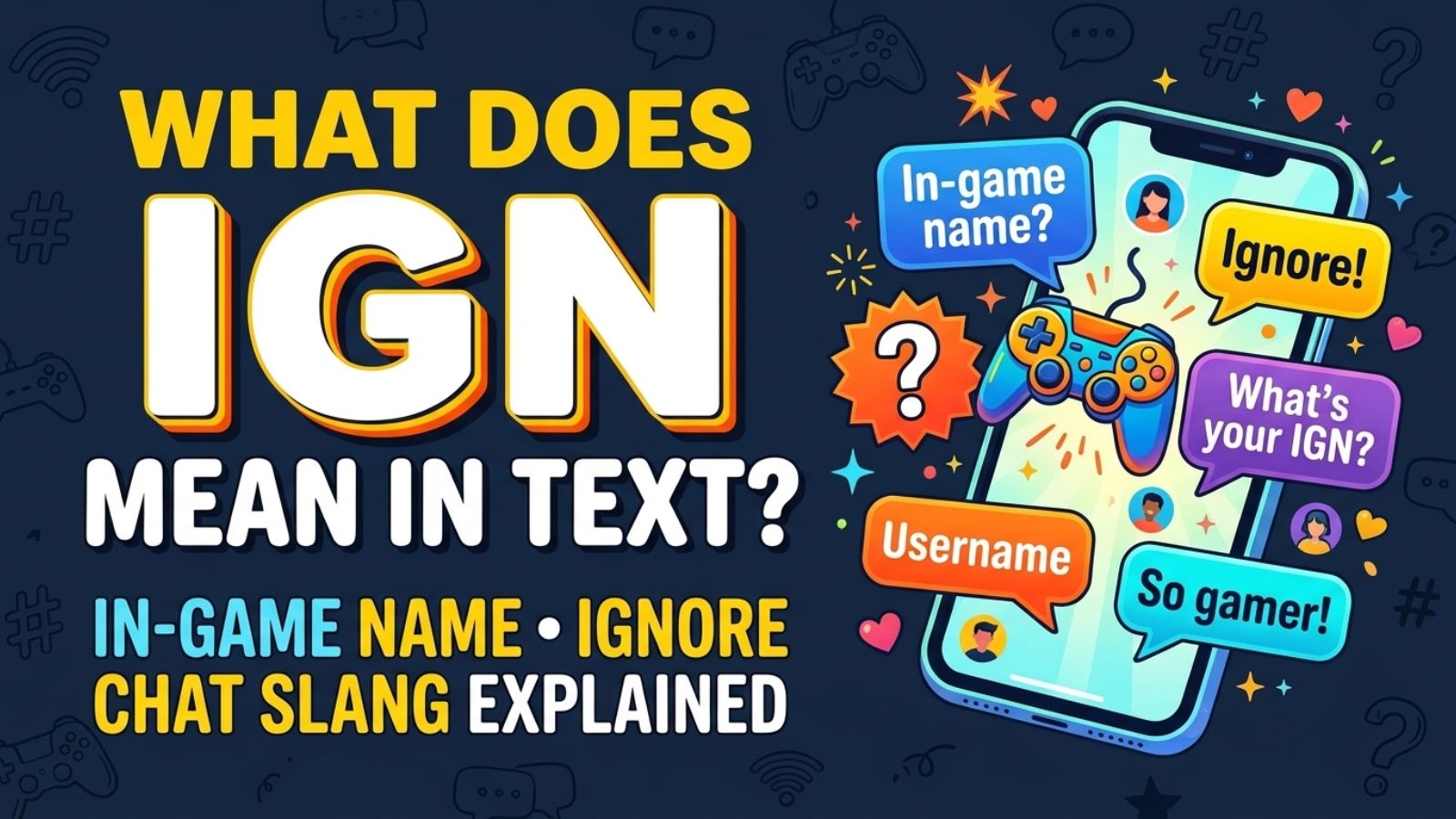
The good news is that IGN is relatively easy to understand once you know the context. It commonly stands for “In-Game Name”, particularly when people are talking about online games. However, it can have other meanings depending on where and how it is used.
In this guide, you will learn what IGN means in texting, why people use it, how to respond, and how to understand it in different situations.
What Does IGN Mean in Text?
IGN means “In-Game Name” in texting and online conversations. It refers to the username or nickname a person uses to identify themselves inside a video game.
For example, if someone asks, “What’s your IGN?” they are usually asking for your gaming username so they can find you, send you a friend request, or play together.
The abbreviation is especially common among online gamers who communicate through gaming chats, social media, and messaging apps.
However, context matters because IGN can also refer to other things, including the gaming and entertainment media brand IGN.
IGN Meaning in Simple Words
In simple words, IGN is the name other players see when you play an online game.
Think of it as your gaming identity.
For example:
- Your real name might be Alex.
- Your gaming username might be ShadowWolf23.
- Your IGN would be ShadowWolf23.
When someone asks for your IGN, they want to know the name associated with your gaming account, not necessarily your real name.
You might need to share it when joining a gaming team, playing with friends, or connecting with other players.
Where Is IGN Used?
IGN is commonly used in online gaming communities and digital conversations.
Here are some places where you might encounter this abbreviation.
1. Online Video Games
Gaming is the most common context for IGN.
Players use it when adding friends, joining multiplayer matches, or identifying teammates.
For example:
“Send me your IGN so I can invite you.”
The person is asking for your in-game username.
2. WhatsApp and Messenger
People sometimes use IGN in private messages when discussing games with friends.
For example:
“What’s your IGN? Let’s play tonight.”
Instead of typing the complete phrase “in-game name,” they use the shorter abbreviation.
3. Discord
Discord is popular among gaming communities, making IGN a familiar abbreviation in its servers and conversations.
For example:
“Drop your IGN in the chat.”
This means players should share their gaming usernames so everyone can connect.
4. Instagram and Other Social Media
You might also see IGN in gaming-related posts, comments, and direct messages.
For example:
“Comment your IGN if you want to join our squad.”
Here, IGN refers to the username used in the particular game.
5. Gaming Communities and Forums
Online gaming forums frequently use IGN when discussing players, competitions, account names, and multiplayer experiences.
For example:
“Please include your IGN when submitting your tournament registration.”
This helps organizers identify participants.
Why Do People Use IGN in Text Messages?
People use IGN because it makes gaming conversations quicker and easier.
Instead of repeatedly writing “in-game name,” they can simply type three letters.
Here are some common reasons people use it.
1. To Save Time
Short abbreviations make online conversations faster.
Typing “What’s your IGN?” is easier than writing “What is your in-game username?”
2. To Add Friends
Many multiplayer games allow players to connect using their usernames.
Someone might ask for your IGN because they want to send you a friend request.
3. To Join a Gaming Team
Gaming groups often need usernames to organize their members.
Sharing your IGN helps teammates recognize you during matches.
4. To Identify Players
Some games have millions of players. A username makes it easier to identify a particular person.
5. To Make Conversations Easier
Gaming communities develop their own vocabulary and abbreviations.
Using familiar terms such as IGN helps players communicate naturally with one another.
Real-Life Examples of IGN in Text Messages
Understanding IGN becomes much easier when you see how people use it in everyday conversations.
Here are some realistic examples.
Example 1: Asking for a Gaming Username
Person A: Hey, do you play PUBG?
Person B: Yes, sometimes.
Person A: What’s your IGN?
Meaning: Person A wants Person B’s in-game username so they can connect in the game.
Example 2: Adding a Friend
Person A: Let’s play together this evening.
Person B: Sure! Send me your IGN.
Meaning: Person B is asking for the gaming username to send a friend request or find the account.
Example 3: Joining a Team
Person A: We’re creating a new gaming squad.
Person B: Sounds interesting. How can I join?
Person A: Share your IGN with us.
Meaning: The team wants the player’s in-game name to identify and add them.
Example 4: Playing Minecraft
Person A: I can’t find your account.
Person B: My IGN is CraftKing45.
Meaning: Person B is sharing the username used in Minecraft.
Example 5: Gaming Tournament
Person A: Don’t forget to submit your IGN before registration closes.
Person B: Okay, I’ll send it shortly.
Meaning: Participants must provide their in-game usernames so tournament organizers can identify them.
Example 6: Finding Someone Online
Person A: I played with someone yesterday, but I forgot their name.
Person B: Do you remember their IGN?
Meaning: Person B is asking whether Person A remembers the player’s gaming username.
Example 7: Inviting a Friend
Person A: I want to invite you to my team.
Person B: Great! Here’s my IGN: NightRider21.
Meaning: Person B shares their in-game identity so the invitation can be sent.
IGN vs. Similar Gaming Terms
IGN is not the only abbreviation used in online gaming. You may encounter several similar terms while chatting with other players.
Here is a simple comparison.
| Term | Full Form | Meaning |
|---|---|---|
| IGN | In-Game Name | Your username inside a game |
| ID | Identification | An account or player identifier |
| UID | User ID | A unique identification number |
| UN | Username | The name used for an account |
| GT | Gamertag | A gaming identity, commonly associated with Xbox |
| NPC | Non-Player Character | A game character not controlled by a player |
| AFK | Away From Keyboard | Temporarily unavailable |
| GG | Good Game | A friendly expression after a match |
Although some of these terms are related, they are not interchangeable.
For example, your IGN might be a username, while your UID is a unique numerical identifier assigned to your account.
IGN Meaning in Different Games
The term IGN is used across many gaming communities.
However, the exact way players find or share their in-game names can differ between games.
Here are a few examples.
IGN in PUBG
In PUBG, players commonly use IGN when referring to their in-game usernames.
Someone might ask:
“What’s your PUBG IGN?”
They want the name displayed on your gaming profile.
IGN in Minecraft
Minecraft players use usernames to identify themselves when joining multiplayer worlds and servers.
For example:
“My Minecraft IGN is BlockMaster.”
This tells other players which username to look for.
IGN in Roblox
In Roblox conversations, IGN can refer to the username associated with a player’s account.
Players may ask for it when trying to find and connect with someone.
IGN in Free Fire
Free Fire players may use IGN when sharing their gaming identities with teammates or other players.
For example:
“Send your Free Fire IGN so I can add you.”
IGN in Fortnite
Fortnite players may use IGN when discussing their gaming names or asking others how to find them.
Depending on the platform and account settings, players may also need an Epic Games display name or another account identifier.
When Should You Use IGN?
You can use IGN when talking about gaming usernames or asking someone to share their in-game identity.
Here are some situations where it makes sense:
- Playing with friends: Ask someone for their IGN before sending a friend request.
- Joining a gaming group: Share your IGN so teammates can identify you.
- Participating in tournaments: Provide your IGN when registration requires it.
- Creating a gaming community: Ask members to share their in-game names.
- Finding another player: Use IGN when asking someone about a particular player’s username.
For example:
“Hey, share your IGN so we can play together.”
This is a natural way to use the abbreviation in a gaming conversation.
However, if you are talking to someone who does not play video games, it is better to write the complete phrase instead.
Common Misunderstandings About IGN
Although IGN usually means “In-Game Name” in gaming conversations, people sometimes misunderstand it.
Here are a few common mistakes to avoid.
1. Thinking IGN Means Real Name
IGN does not normally refer to your actual name.
It means the username or nickname associated with your gaming identity.
For example, your real name might be Daniel, while your IGN is DragonKing.
2. Confusing IGN With Gaming ID
An IGN and a gaming ID are not necessarily the same thing.
An IGN usually refers to your displayed in-game name, while a gaming ID may refer to a unique account identifier.
3. Assuming IGN Has Only One Meaning
Context is important.
IGN can also refer to IGN , a well-known gaming and entertainment media brand that publishes reviews, news, guides, and other content.
For example:
“I watched an IGN review of the new game.”
In this sentence, IGN refers to the media company rather than an in-game username.
4. Thinking Everyone Uses the Same Username
Some players use different usernames across different games.
Your IGN in one game might not match your username in another.
Therefore, always check which game someone is talking about before sharing your username.
Pro Tips for Using IGN Correctly
If you regularly chat with gamers, understanding a few simple tips can make your conversations easier.
1. Understand the context: If someone mentions gaming, IGN probably means “In-Game Name.”
2. Use it naturally: You can write “What’s your IGN?” when asking another player for their username.
3. Know the difference between usernames and IDs: Some games require a username, while others use numerical account identifiers.
4. Check your spelling: When sharing your IGN, make sure you provide the correct spelling so other players can find you.
5. Protect your account: Sharing your public gaming username is different from sharing your password or private account information. Never give anyone your password or verification codes.
6. Avoid confusion: If someone does not understand the abbreviation, simply explain that it means “In-Game Name.”
Final Thoughts
So, what does IGN mean in text?
IGN most commonly stands for “In-Game Name.” It refers to the username or nickname you use when playing an online video game.
You will often see it in gaming conversations on WhatsApp, Discord, Instagram, and multiplayer platforms.
When someone asks, “What’s your IGN?” they usually want your gaming username so they can find you or play together.
Just remember that IGN can also refer to the popular gaming and entertainment media brand, depending on the conversation.
Once you understand the context, recognizing and using IGN becomes simple.
Frequently Asked Questions (FAQs)
1. What does IGN stand for in texting?
IGN stands for “In-Game Name” in most gaming-related text conversations. It refers to the username or nickname a person uses inside a video game.
2. What does What’s Your IGN mean?
“What’s your IGN?” means “What is your in-game name?” Someone is usually asking for your gaming username so they can find you, add you, or play with you.
3. Is IGN the same as a username?
They are closely related but not always identical. IGN refers specifically to your in-game name, while a username can identify your account on almost any website or platform.
4. Can IGN have another meaning?
Yes. Besides “In-Game Name,” IGN can refer to the gaming and entertainment media company known for video game reviews, news, and entertainment coverage. The intended meaning depends on the context.