Have you received a message containing OT and wondered what the person was trying to say? You are not alone. Internet slang can be confusing, especially when someone uses two letters instead of a complete phrase.
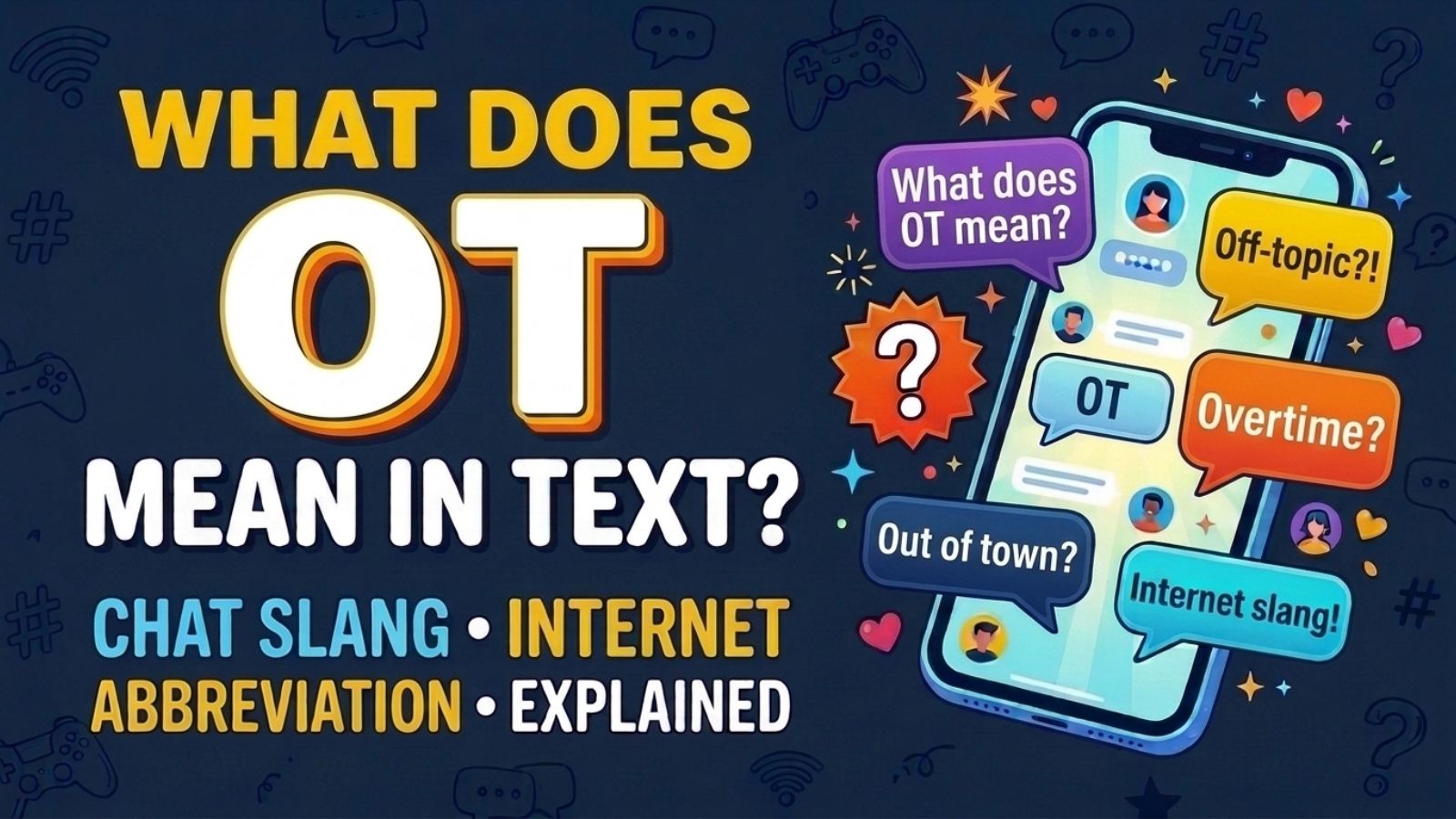
The abbreviation OT has several meanings in texting, social media, and everyday online conversations. Its meaning usually depends on the topic, the person using it, and the surrounding message.
Sometimes, it means Off Topic, while in other situations, it stands for Overtime. Understanding the context can help you avoid misunderstandings and respond naturally.
In this guide, you will learn what OT means in text messages, why people use it, where you might see it, and how to understand it through everyday examples.
What Does OT Mean in Text?
OT most commonly means “Off Topic” or “Overtime” in text messages, depending on the conversation.
- Off Topic: Used when someone discusses something unrelated to the main subject.
- Overtime: Used when someone talks about extra working hours, sports, or additional time beyond the regular period.
For example:
- “Sorry, this is OT, but have you watched that movie?” Here, OT means Off Topic.
- “I’m working OT tonight.” Here, OT means Overtime.
The surrounding words usually make the intended meaning clear.
What Is the Simple Meaning of OT?
In simple words, OT is a short way of communicating something without typing the full expression.
Think of it as an abbreviation whose meaning changes depending on what you are discussing.
Here are the two main meanings in everyday communication:
1. OT Means Off Topic
When someone says something is OT, they mean it is not directly connected to the current conversation.
For example:
“OT, but does anyone know when the school event starts?”
The person is changing the subject or introducing a separate question.
You may see this meaning in:
- Group chats
- Online discussion forums
- Social media comments
- Gaming communities
- Community message boards
2. OT Means Overtime
OT can also refer to additional time beyond a normal work schedule or the regular playing period in a sports match.
For example:
“I have to do OT this weekend.”
This means the person has to work extra hours.
In sports, someone might say:
“The match went into OT.”
That means the game continued into an additional period because the result was still undecided.
Where Is OT Used in Text Messages?
OT appears in several online and everyday communication settings. The intended meaning depends on what people are discussing.
Here are some common situations.
1. WhatsApp and Personal Messages
Friends may use OT when they want to introduce an unrelated subject.
Example:
“OT, did you hear about the new school schedule?”
The sender is moving away from the previous discussion to ask a different question.
2. Instagram and Facebook
You might see OT in comments, group conversations, or discussions about a particular subject.
Example:
“Sorry, this is OT, but I really like your new profile picture.”
Here, the person acknowledges that their comment is unrelated to the original topic.
3. Snapchat and Casual Chats
In casual conversations, OT can be used as a quick abbreviation when someone wants to change the subject.
Example:
“OT, are you free tomorrow?”
The sender is asking something unrelated to the previous conversation.
4. Workplace Messages
In workplace conversations, OT usually refers to overtime.
Example:
“My manager asked me to work OT today.”
The employee is explaining that they need to work additional hours.
5. Sports Discussions
Sports fans frequently use OT when discussing games that continue beyond regular playing time.
Example:
“That was an amazing goal in OT!”
The goal happened during the overtime period.
These different uses are also reflected in online slang references and English dictionaries. What does OT stand for?+2
Why Do People Use OT in Text Messages?
People use abbreviations because they make everyday communication quicker and more convenient.
Instead of writing a complete phrase, they can use two simple letters.
Here are some common reasons:
1. To Save Time
Typing OT is quicker than typing “off topic” or “overtime,” especially when someone is sending a short message.
2. To Change the Subject
When people want to introduce a different topic, OT can signal that the next message is unrelated to the current discussion.
3. To Keep Messages Short
Short abbreviations make casual conversations feel less formal and easier to follow.
4. To Communicate at Work
Employees often use OT when discussing extra shifts, working hours, and schedules.
5. To Discuss Sports Quickly
Sports fans use OT because it is a familiar abbreviation for overtime.
The main advantage is convenience, but the reader still needs context to understand the intended meaning.
Examples of OT in Text Messages
The easiest way to understand OT is to look at how people use it in everyday conversations.
Below are some realistic examples with explanations.
Example 1: Changing the Subject
Person A: “Did you complete the project?”
Person B: “Almost done. OT, have you seen the latest announcement?”
Meaning: Person B is introducing something unrelated to the project.
Example 2: Extra Working Hours
Person A: “Why can’t you join us tonight?”
Person B: “I have OT at work.”
Meaning: Person B needs to work additional hours.
Example 3: Talking About Sports
Person A: “How was the basketball game?”
Person B: “It was incredible. The game went into OT!”
Meaning: The game continued into an overtime period.
Example 4: An Unrelated Question
Person A: “We should discuss the weekend plans.”
Person B: “Sure. OT, what time does the bus leave?”
Meaning: Person B is asking a separate question that does not directly relate to the weekend plans.
Example 5: Workplace Scheduling
Person A: “Are you working tomorrow?”
Person B: “Yes, but only a few hours of OT.”
Meaning: Person B will work some additional hours.
Example 6: Online Discussion
Person A: “Let’s keep this conversation about photography.”
Person B: “Sorry, my last comment was OT.”
Meaning: Person B acknowledges that their comment was unrelated to photography.
Example 7: Sports Competition
Person A: “Who won the final?”
Person B: “The home team scored during OT.”
Meaning: The winning score happened during overtime.
Example 8: Casual Conversation
Person A: “I’m going to the library after school.”
Person B: “OT, did you finish reading that book?”
Meaning: Person B has introduced another subject.
OT vs. Similar Text Abbreviations
OT can sometimes be confused with other short expressions. Understanding the differences will help you interpret messages more accurately.
| Abbreviation | Full Form | Meaning |
|---|---|---|
| OT | Off Topic | Something unrelated to the discussion |
| OT | Overtime | Extra working or playing time |
| OTOH | On the Other Hand | Introduces an alternative viewpoint |
| BTW | By the Way | Introduces additional information |
| FYI | For Your Information | Shares useful information |
| BRB | Be Right Back | Indicates a short absence |
| IDK | I Don’t Know | Expresses uncertainty |
For example, if someone writes “BTW, I have a question,” they are adding information or introducing another point.
If they write “OT, I have a question,” they are specifically indicating that the subject is unrelated to the current discussion.
When Should You Use OT?
OT is appropriate when you are having an informal conversation and the meaning is clear from the context.
Here are some situations where using it makes sense:
- With friends: When introducing a different subject in a casual conversation.
- In group chats: When asking something unrelated to the group’s main discussion.
- At work: When discussing additional working hours with colleagues.
- During sports discussions: When talking about an overtime period.
- In online communities: When identifying a comment that does not relate to the main topic.
However, avoid using abbreviations when they might confuse your audience.
For formal emails, school assignments, professional documents, or important announcements, writing the complete phrase is usually better.
For example, instead of writing “I will be doing OT tomorrow,” you can write “I will be working overtime tomorrow.”
This makes your message clearer, especially when the reader is unfamiliar with the abbreviation.
Common Misunderstandings About OT
Although OT is a simple abbreviation, people sometimes misunderstand it.
Here are a few common mistakes to avoid.
1. Assuming OT Always Means Off Topic
Not every OT message is about changing subjects.
If someone says, “I’m doing OT tonight,” they are probably talking about overtime at work.
2. Thinking OT Is Always About Work
OT is also used in online discussions and sports conversations.
The surrounding message helps determine the correct meaning.
3. Confusing It With a Typing Mistake
Sometimes, people assume OT is a random combination of letters.
However, it is an established abbreviation with recognized meanings in online communication and everyday English.
4. Assuming It Is Rude
OT is not inherently rude or offensive.
It is generally a neutral abbreviation. However, changing the subject at an inappropriate moment can make a message seem inconsiderate.
5. Ignoring the Conversation
One of the biggest mistakes is interpreting two letters without considering the complete message.
Always read the surrounding sentence before deciding what someone means.
Other Possible Meanings of OT
Although Off Topic and Overtime are common interpretations, OT has other meanings in specific situations.
Here are a few worth knowing:
| Meaning | Context |
|---|---|
| Occupational Therapy | Healthcare and rehabilitation |
| Occupational Therapist | Healthcare professionals |
| Old Testament | Religious discussions |
| Out of Town | Some informal conversations |
| Original Trilogy | Movie discussions, particularly franchise-related conversations |
For example, if someone says, “I have an OT appointment tomorrow,” they may be referring to an occupational therapy appointment.
Similarly, “I’m going OT this weekend” could mean “I’m going out of town” in a context where that informal usage is understood.
These meanings are context-specific and should not automatically be assumed in ordinary texting. English meaning – Cambridge Dictionary+2
Pro Tips for Understanding OT Correctly
Want to understand OT without getting confused? Keep these practical tips in mind.
- Read the complete message: Never decide what OT means based on the abbreviation alone.
- Consider the topic: A conversation about work probably points toward overtime, while an unrelated comment in a discussion may indicate off topic.
- Pay attention to the situation: Sports, healthcare, and everyday conversations can give OT different meanings.
- Ask for clarification: If you are unsure, simply ask, “What do you mean by OT?”
- Avoid unnecessary abbreviations: When communicating with someone unfamiliar with texting slang, use complete phrases.
The best way to understand internet slang is to consider the entire conversation rather than focusing on individual letters.
Final Thoughts
So, what does OT mean in text?
The two main meanings are Off Topic and Overtime. When someone uses OT in an online discussion, they may be introducing an unrelated subject. In workplace or sports conversations, it usually refers to additional time.
The important thing is context. Pay attention to the topic and surrounding words before deciding what the sender means.
Once you understand these meanings, recognizing OT in everyday messages becomes much easier.
Frequently Asked Questions (FAQs)
1. What does OT stand for in texting?
OT commonly stands for Off Topic or Overtime in texting. The intended meaning depends on the conversation. It can also have other meanings in specific settings, such as occupational therapy in healthcare.
2. Does OT mean off topic in chat?
Yes. In online discussions and group chats, OT often means Off Topic. People use it when introducing a subject that is unrelated to the main conversation.
3. What does OT mean on Instagram?
On Instagram, OT can mean Off Topic when someone introduces an unrelated comment or question. However, its meaning can change depending on the conversation.
4. Is OT slang or an abbreviation?
OT is an abbreviation rather than a traditional slang word. It is commonly used in informal digital communication, online discussions, workplace messages, and sports conversations.