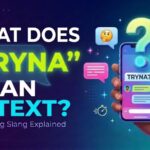
If you have seen “tryna” in a text message, social media post, or online conversation, you may be wondering what it means. Tryna is an informal slang term commonly used in texting and casual speech. It usually means “trying to” and helps people express what they want to do or what they are attempting to do.
For example, someone might text, “I’m tryna sleep,” which means “I’m trying to sleep.” The spelling is casual, so you will see it more often in conversations with friends than in formal writing.
In this guide, you will learn what tryna means in text, how to use it, how it differs from similar expressions, and how to understand it in different conversations.
What Does Tryna Mean in Text?
Tryna means “trying to” in informal English. People use it in text messages, online chats, social media comments, and casual conversations to communicate their intentions, efforts, or plans.
The word is a shortened, informal representation of how “trying to” can sound when spoken quickly. It is not standard formal English, but it is widely recognizable in many casual English-speaking contexts.
Here are a few examples:
- “I’m tryna finish my homework.” — I’m trying to finish my homework.
- “You tryna go out tonight?” — Are you trying to go out tonight?
- “I’m tryna understand what happened.” — I’m trying to understand what happened.
- “We tryna help you.” — We are trying to help you.
The exact meaning depends on the context. In some conversations, tryna describes an effort. In others, it expresses an intention or asks whether someone wants to do something.
For instance, “I’m tryna get some food” could mean that someone is attempting to get food or expressing an intention to get something to eat.
What Does Tryna Stand For?
Tryna stands for “trying to.” It is a casual spelling that represents the pronunciation of the phrase when the words are spoken quickly and connected together.
| Informal expression | Standard English |
|---|---|
| Tryna | Trying to |
| I’m tryna leave | I’m trying to leave |
| Tryna call you | Trying to call you |
| You tryna come? | Are you trying to come? |
| We tryna figure it out | We’re trying to figure it out |
Unlike an acronym, tryna is not formed from the first letters of several words. It is a colloquial spelling based on spoken English.
It is also different from a formal abbreviation such as “ASAP,” which stands for “as soon as possible.” Tryna represents the sound of a phrase rather than the initials of its words.
How Is Tryna Used in Text Messages?
People use tryna in several ways, depending on what they want to communicate. Understanding these common patterns can help you interpret messages more naturally.
1. To Describe an Attempt
Tryna can describe something a person is making an effort to do.
Examples:
- “I’m tryna fix my laptop.”
- “She’s tryna learn Spanish.”
- “I’m tryna find my keys.”
- “They’re tryna solve the problem.”
In each example, the person is attempting to do something. The expression does not guarantee success; it simply communicates the effort.
2. To Express an Intention
In casual conversation, tryna can also communicate what someone intends or hopes to do.
Examples:
- “I’m tryna get some rest.”
- “I’m tryna save money this month.”
- “I’m tryna start a new hobby.”
- “I’m tryna improve my English.”
These messages describe personal goals or intended actions. Depending on the situation, the speaker may already be taking steps toward the goal or may simply be expressing an intention.
3. To Ask Whether Someone Wants to Do Something
A question containing tryna may ask about another person’s plans or willingness to participate in an activity.
Examples:
- “You tryna hang out?”
- “You tryna grab lunch?”
- “Y’all tryna watch a movie?”
- “You tryna play some games later?”
In these situations, the speaker often means something close to “Do you want to hang out?” or “Would you like to grab lunch?”
The expression is casual, and its precise meaning depends on the context. A message such as “You tryna help me?” could ask whether someone is willing to help rather than whether they are already making an attempt.
4. To Talk About Relationships or Social Plans
Tryna sometimes appears in messages about dating, friendship, or personal intentions.
Examples:
- “I’m tryna get to know you.”
- “He’s tryna talk to her.”
- “I’m tryna make new friends.”
- “Are you tryna meet up later?”
These sentences communicate interest or a possible plan. However, tryna alone does not necessarily indicate romantic interest. The surrounding conversation determines whether the message is friendly, romantic, or simply practical.
Tryna vs. Trying To: What’s the Difference?
The main difference between tryna and trying to is formality and spelling. Both can communicate the same basic idea, but they are appropriate in different situations.
| Feature | Tryna | Trying to |
|---|---|---|
| Style | Informal slang | Standard English |
| Common setting | Texts, chats, casual speech | Casual and formal communication |
| Spelling | Nonstandard | Standard |
| School assignments | Usually avoid | Appropriate |
| Professional emails | Usually avoid | Appropriate |
| Example | I’m tryna call you. | I’m trying to call you. |
Consider these examples:
Informal text:
“I’m tryna finish this project before dinner.”
Standard English:
“I’m trying to finish this project before dinner.”
Both communicate the same general meaning. The first sounds casual, while the second is suitable for a wider range of situations.
If you are chatting with friends, tryna may fit naturally. If you are writing an academic essay, job application, business email, or formal report, use “trying to.”
Is Tryna Correct English?
Tryna is a recognizable form of informal English, but it is not considered standard spelling in formal writing.
Whether it is appropriate depends on the purpose and audience of your communication.
When Tryna Is Appropriate
Tryna may be suitable for:
- Casual text messages between friends.
- Informal social media posts and comments.
- Dialogue in a story when a character speaks casually.
- Conversations that intentionally reproduce informal speech.
- Lyrics or creative writing where the spelling reflects pronunciation.
For example:
“I’m tryna figure out what to wear tonight.”
This works as an informal text message.
When You Should Avoid Tryna
Use “trying to” instead when writing:
- Academic essays and school assignments.
- Professional emails and business reports.
- Formal applications and official documents.
- Instructions that require standard written English.
- Most formal articles and educational materials.
For example:
Informal: “I’m tryna complete the assignment.”
Standard: “I’m trying to complete the assignment.”
The second version is the better choice for schoolwork and professional communication.
Remember that informal language is not automatically bad English. Different forms of English serve different purposes. The important skill is knowing when to use each form.
Common Mistakes When Using Tryna
Although tryna is easy to recognize, a few common mistakes can make messages unclear.
Mistake 1: Using Tryna in Formal Writing
Incorrect for a formal essay: “The researcher is tryna explain the results.”
Better: “The researcher is trying to explain the results.”
The informal spelling does not suit the formal tone expected in academic writing.
Mistake 2: Forgetting the Meaning of the Whole Sentence
Consider this message:
“I’m tryna call you.”
It means the person is trying to call you. It does not necessarily mean the call has already connected or that the person has successfully spoken to you.
Always consider the action and its context rather than assuming that an intended action has been completed.
Mistake 3: Assuming Tryna Always Means Want To
Tryna can sometimes express a desire or intention, but it is not always interchangeable with “want to.”
Compare:
- “I’m tryna fix my phone.” — I’m trying to fix my phone.
- “I want to fix my phone.” — I have the desire or intention to fix my phone.
The first emphasizes an attempt, while the second emphasizes a desire or intention. In some casual conversations, their meanings may overlap, but they are not identical in every situation.
Mistake 4: Treating Tryna as a Formal Abbreviation
Tryna is not an official abbreviation that belongs in every type of writing. It is a nonstandard spelling associated with informal speech.
If you need standard English, write the full phrase “trying to.”
Mistake 5: Misunderstanding a Question
A message such as “You tryna come?” often means “Do you want to come?” or “Are you planning to come?”
It is not always asking whether you are physically attempting to come somewhere. The social context helps determine the intended meaning.
Tryna vs. Wanna vs. Gonna
Tryna is often used alongside other informal expressions such as wanna and gonna. Although they look similar, they have different meanings.
| Slang word | Standard expression | Example |
|---|---|---|
| Tryna | Trying to | I’m tryna learn. |
| Wanna | Want to | I wanna learn. |
| Gonna | Going to | I’m gonna learn. |
Tryna
Tryna usually emphasizes an attempt or intention.
Example: “I’m tryna finish my book.”
Meaning: I’m trying to finish my book.
Wanna
Wanna generally means “want to” and expresses a desire or wish.
Example: “I wanna read that book.”
Meaning: I want to read that book.
Gonna
Gonna generally represents “going to” and is commonly used to express a future plan, intention, or prediction.
Example: “I’m gonna read that book tonight.”
Meaning: I’m going to read that book tonight.
These expressions can overlap in casual conversation, but they are not interchangeable in every sentence. Choosing the right one helps communicate your meaning clearly.
How to Reply When Someone Texts Tryna
Your response depends on what the person is asking or telling you.
Here are some examples of possible replies.
Message: “You tryna hang out later?”
- If you agree: “Yeah, sounds good!”
- If you are unsure: “Maybe. What time?”
- If you are unavailable: “Not today, maybe another time.”
Message: “I’m tryna finish my homework.”
- Supportive reply: “You got this!”
- Helpful reply: “Need any help?”
- Casual reply: “Same, I’m working on mine too.”
Message: “I’m tryna call you.”
- If you missed the call: “Sorry, I missed it. Call me again.”
- If you are available: “I’m free now. Give me a call.”
You do not need to use slang in your reply just because the other person used it. A natural response in your usual communication style is perfectly fine.
How to Understand Tryna in Different Contexts
The same word can communicate slightly different intentions depending on the conversation.
| Text message | Likely meaning |
|---|---|
| “I’m tryna sleep.” | I’m trying to sleep. |
| “I’m tryna get better.” | I’m making an effort to improve. |
| “You tryna eat?” | Do you want to get something to eat? |
| “He’s tryna impress her.” | He’s trying to impress her. |
| “We tryna leave early.” | We’re trying or intending to leave early. |
| “I’m not tryna argue.” | I don’t want to argue or get into an argument. |
The final example is especially useful. In casual speech, “I’m not tryna argue” often means “I don’t want to argue.” Here, the expression communicates a person’s attitude or intention rather than simply describing a physical attempt.
To understand a message accurately, look at the words around tryna, the conversation’s topic, and the relationship between the people communicating.
Tips for Learning Informal English Slang
If you are learning English, recognizing expressions such as tryna can make online conversations easier to understand.
Use these simple tips:
- Learn the standard phrase first. Remember that tryna usually represents “trying to.”
- Read the whole sentence. Context can reveal whether someone is describing an effort, expressing an intention, or asking about plans.
- Notice the setting. Slang is more common in casual conversations than in formal documents.
- Compare similar expressions. Understanding the differences between tryna, wanna, and gonna helps you interpret messages more accurately.
- Practice both forms. Learn to recognize informal slang while using standard English when the situation requires it.
You do not need to use every slang word you encounter. Understanding what expressions mean is just as useful as knowing how to use them yourself.
Frequently Asked Questions
1. What does tryna mean in text from a guy?
When a guy texts tryna, it usually means “trying to.” For example, “I’m tryna see you” may mean he is trying or hoping to meet you. The message could be friendly or romantic, depending on your relationship and the surrounding conversation.
2. Does tryna mean trying to or want to?
Tryna literally represents “trying to,” but it can sometimes communicate a desire or intention. For example, “You tryna hang out?” often means “Do you want to hang out?” The context determines the most natural interpretation.
3. Is tryna the same as wanna?
No. Tryna usually means “trying to,” while wanna means “want to.” For example, “I’m tryna learn” emphasizes an attempt, whereas “I wanna learn” emphasizes a desire.
4. Is tryna a real word?
Tryna is an established informal slang spelling used in casual English. However, it is not standard spelling for formal writing. In school assignments, professional documents, and formal communication, use “trying to.”
5. What does “I’m not tryna” mean?
“I’m not tryna” usually means “I’m not trying to” or, depending on context, “I don’t want to.” For example, “I’m not tryna fight” generally means “I don’t want to fight.”
6. Should I use tryna in school writing?
Generally, no. Unless you are writing dialogue or discussing informal language, use “trying to” in school assignments. The standard phrase is clearer and more appropriate for academic English.
Conclusion
The expression tryna usually means “trying to” in text messages and casual conversations. It can describe an effort, express an intention, or ask whether someone wants to participate in an activity. Its precise meaning depends on the context.
Tryna is common in informal communication, but “trying to” is the better choice for academic, professional, and other formal writing. By understanding the difference between tryna, wanna, and gonna, you can interpret everyday messages more confidently and choose language that fits the situation.