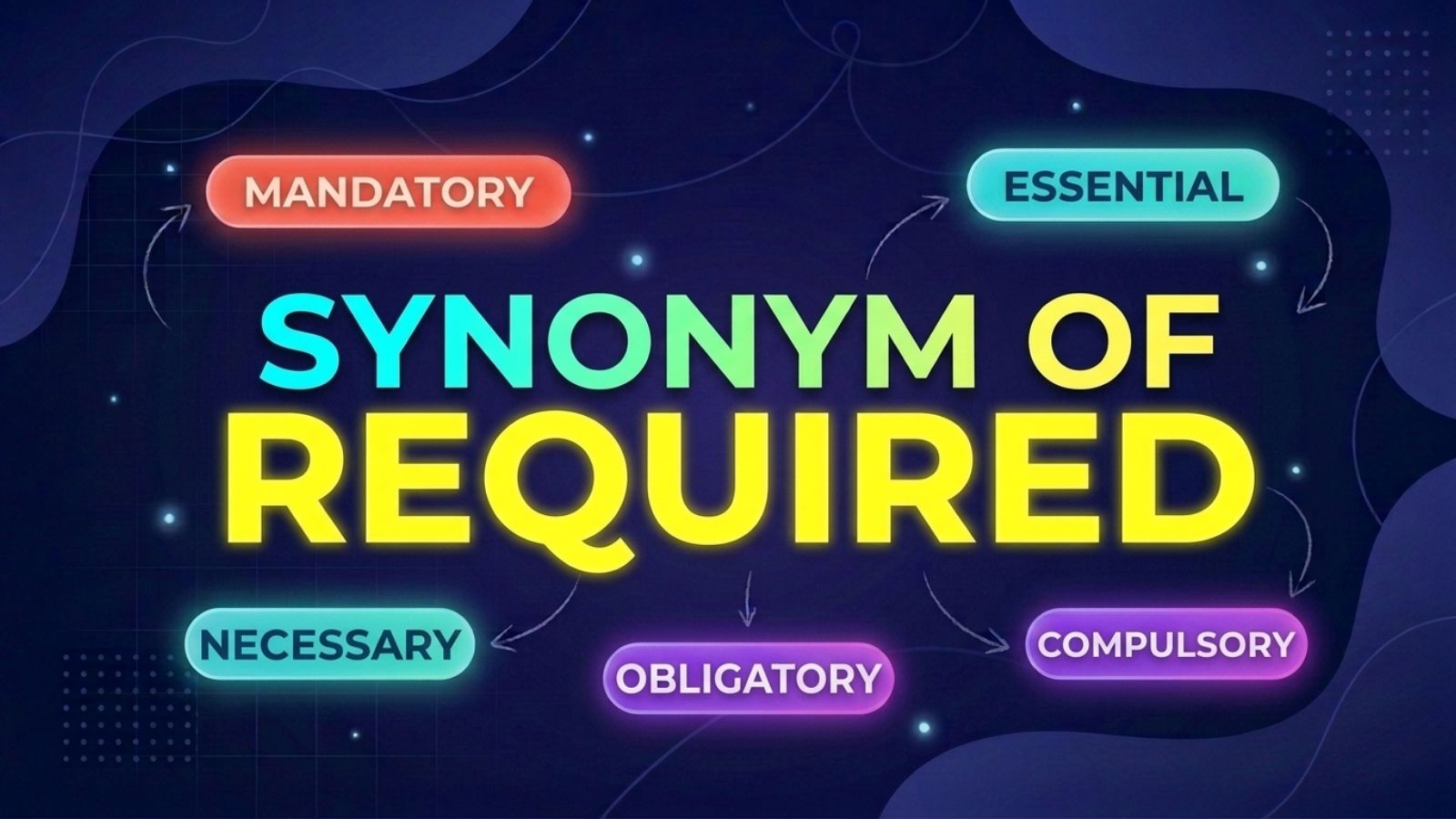
Finding the right synonym of required can make your writing clearer, more professional, and more precise. Common alternatives include necessary, essential, mandatory, compulsory, needed, and obligatory. However, these words are not interchangeable in every situation. Some describe something that must be done because of a rule, while others emphasize importance, necessity, or practical need.
Whether you are writing an academic assignment, preparing a business document, improving your vocabulary, or learning English, choosing the right alternative depends on your sentence and intended meaning. This guide explains useful synonyms for required, provides natural examples, and shows when to use each word.
What Does Required Mean?
Required means needed, necessary, or officially demanded for a particular purpose. It often describes something that a person must do, provide, possess, or complete.
Required is commonly used as an adjective and as the past participle of the verb require.
In simple English, if something is required, you need it or must do it to meet a particular condition.
Examples:
- A valid identification card is required to enter the building.
- Students must complete the required reading before class.
- No additional equipment is required for this activity.
- Applicants are required to submit their forms before the deadline.
The exact meaning depends on the context. A required document may be officially demanded, while a required ingredient may simply be necessary for a recipe.
Best Synonyms of Required
The following words are among the most useful alternatives to required. Each has a slightly different meaning or level of force.
1. Necessary
Meaning: Needed for a particular purpose or result.
Necessary is one of the closest general alternatives to required. It emphasizes need rather than an official rule.
Example: Regular practice is necessary to improve your writing skills.
2. Essential
Meaning: Absolutely important or indispensable for a particular purpose.
Use essential when something is especially important or cannot reasonably be left out.
Example: Clear communication is essential for successful teamwork.
3. Mandatory
Meaning: Required by a rule, law, policy, or official instruction.
Mandatory is especially useful in formal, legal, educational, and workplace contexts.
Example: Attendance at the safety training session is mandatory.
4. Compulsory
Meaning: Required by an authority, rule, or regulation rather than left to personal choice.
Compulsory is common in education and official requirements.
Example: Mathematics is a compulsory subject in this course.
5. Obligatory
Meaning: Required by a law, rule, duty, or accepted obligation.
This word has a formal tone and often emphasizes responsibility.
Example: Wearing protective equipment is obligatory in this work area.
6. Needed
Meaning: Necessary or wanted for a particular purpose.
Needed is a simple, natural alternative for everyday English.
Example: All the materials needed for the experiment are on the table.
7. Demanded
Meaning: Insisted upon or requested firmly.
Demanded is not a direct substitute in every sentence because it often suggests a strong request or insistence.
Example: The authorities demanded additional documentation.
8. Stipulated
Meaning: Specified as a condition or requirement in an agreement, contract, or formal arrangement.
This is a useful formal alternative when a requirement has been clearly stated.
Example: The contract stipulated that payment must be made within 30 days.
9. Prescribed
Meaning: Set down or specified by an authority, rule, or established procedure.
It often appears in legal, medical, academic, and technical contexts.
Example: Applicants must follow the prescribed application procedure.
10. Indispensable
Meaning: So important or necessary that something cannot be done properly without it.
Indispensable is stronger than the general word required.
Example: Reliable data is indispensable to an accurate analysis.
More Synonyms for Required
These additional alternatives can help you express different kinds of requirements more precisely.
11. Needed
Used when something is necessary to complete a task or achieve a result.
Example: More information is needed to resolve the issue.
12. Essential
Suitable when emphasizing that something is fundamental or cannot be omitted.
Example: Accurate measurements are essential for the experiment.
13. Imperative
Meaning: Extremely important or necessary.
This word emphasizes urgency or importance rather than an official obligation in every case.
Example: It is imperative that the team address the safety concern promptly.
14. Requisite
Meaning: Necessary for a particular purpose or position.
This is a formal word often used in professional and academic writing.
Example: Candidates must possess the requisite qualifications.
15. Due
Meaning: Expected, owed, or scheduled at a particular time, depending on the context.
It is not a general synonym for required, but it can be appropriate when discussing obligations or deadlines.
Example: The completed assignment is due on Friday.
16. Expected
Meaning: Regarded as necessary, appropriate, or likely in a particular situation.
Unlike mandatory, expected does not always mean legally or officially required.
Example: Employees are expected to follow the company’s professional conduct guidelines.
17. Obligated
Meaning: Bound by a duty, commitment, or responsibility to do something.
This word usually describes a person or organization rather than an item.
Example: Tenants are obligated to follow the terms of their lease.
18. Binding
Meaning: Legally or formally enforceable.
Use binding when an agreement, decision, or obligation must be followed.
Example: Both parties signed a binding agreement.
19. Enforced
Meaning: Made to be obeyed or followed.
Enforced describes how a rule or requirement is applied, rather than simply stating that something is required.
Example: The school strictly enforced its identification policy.
20. Fundamental
Meaning: Basic and essential to the nature or operation of something.
It can replace required only when the intended meaning is something essential or foundational.
Example: Critical thinking is fundamental to effective problem-solving.
Formal Synonyms for Required
When writing academic assignments, professional emails, reports, or official documents, choose a word that communicates the exact type of requirement.
| Synonym | Meaning or context | Example |
|---|---|---|
| Mandatory | Officially required | Safety training is mandatory. |
| Compulsory | Required by a rule or authority | Attendance is compulsory. |
| Obligatory | Required as a duty or obligation | Protective clothing is obligatory. |
| Requisite | Necessary for a specific purpose | The applicant has the requisite experience. |
| Stipulated | Explicitly specified as a condition | The agreement stipulated a payment date. |
| Prescribed | Set by an official procedure or standard | Follow the prescribed method. |
| Indispensable | Absolutely necessary | Trust is indispensable to collaboration. |
| Imperative | Urgently important or necessary | Immediate action is imperative. |
For academic writing, necessary, essential, and requisite are often useful. For regulations and policies, mandatory, compulsory, and obligatory are generally more precise.
Synonyms for Required in Different Contexts
The best alternative depends on what is being required and why.
1. Required in Academic Writing
Academic writing often discusses information, methods, qualifications, and conditions that are needed to complete a task.
Useful alternatives include:
- Necessary: Needed to achieve a result.
- Essential: Fundamental to the argument or process.
- Requisite: Required for a specific purpose.
- Mandatory: Officially required by a course or institution.
- Fundamental: Basic to understanding a subject.
Examples:
- Original: Evidence is required to support the argument.
- Alternative: Evidence is necessary to support the argument.
- Original: Students must complete the required coursework.
- Alternative: Students must complete the mandatory coursework.
Use necessary when explaining what a task needs. Use mandatory when referring to an official academic rule.
2. Required in Business and the Workplace
In professional settings, requirements may concern responsibilities, documents, skills, procedures, or deadlines.
Useful alternatives include:
- Mandatory: Required by company policy.
- Essential: Important for successful performance.
- Requisite: Needed for a position or task.
- Stipulated: Specified in an agreement.
- Expected: Regarded as a normal responsibility.
- Obligatory: Required as part of a duty.
Examples:
- All employees must complete the mandatory safety course.
- Applicants must demonstrate the requisite technical skills.
- The contract includes the stipulated reporting requirements.
These alternatives help avoid repetition while preserving the intended meaning.
3. Required in Legal and Official Documents
Legal and official writing often distinguishes between something that is compulsory, something specified by a document, and something that is legally enforceable.
Useful alternatives include:
- Mandatory: Required by a rule or law.
- Obligatory: Required as a duty.
- Binding: Legally or formally enforceable.
- Stipulated: Specified as a condition.
- Prescribed: Established by an applicable rule or procedure.
Example: The parties must comply with the obligations stipulated in the agreement.
Be precise when writing about legal matters. A condition described as binding has a different emphasis from one that is simply necessary.
4. Required in Everyday English
For everyday conversations, simpler alternatives often sound more natural.
- Needed: We have all the supplies needed for the trip.
- Necessary: A ticket is necessary to enter the event.
- Expected: Visitors are expected to arrive on time.
- Must-have: A casual expression for something considered essential.
- Important: A broad term that emphasizes value, although it does not necessarily mean required.
Example: No special equipment is needed for this exercise.
In casual writing, needed is often clearer than requisite or obligatory.
Required vs. Necessary vs. Mandatory
These words are closely related, but their meanings differ in important ways.
| Word | Main emphasis | Example |
|---|---|---|
| Required | Something that must be provided or done under particular conditions | A signature is required on the form. |
| Necessary | Something needed for a purpose or result | A signature is necessary to validate the form. |
| Mandatory | Something officially demanded by a rule or authority | A signature is mandatory under the procedure. |
Required is a broad term. It may refer to a practical need, an instruction, or an official condition.
Necessary focuses on need. Something can be necessary even when no formal rule demands it.
Mandatory specifically emphasizes an obligation imposed by a rule, policy, or authority.
For example, water is necessary for human survival, but carrying a particular water bottle is not generally mandatory.
What Is the Opposite of Required?
The opposite of required depends on the context. These words describe something that is not necessary, not compulsory, or left to personal choice.
- Optional: Not compulsory; a person can choose whether to do it.
- Voluntary: Done by choice rather than obligation.
- Unnecessary: Not needed.
- Nonessential: Not fundamental or indispensable.
- Discretionary: Decided according to personal judgment or choice.
- Elective: Chosen rather than automatically included or compulsory, especially in education.
Examples:
- Attendance at the extra workshop is optional.
- Participation in the community project is voluntary.
- The additional equipment is unnecessary for this task.
- Students can choose an elective subject.
Remember that optional and voluntary are not always interchangeable. Optional means there is a choice, while voluntary emphasizes that participation is by choice rather than compulsion.
Common Mistakes When Using Synonyms for Required
1. Using important instead of required
Something can be important without being compulsory.
❌ The additional reading is important, so every student must submit it.
✅ The additional reading is required, so every student must submit it.
The first sentence does not clearly establish an obligation unless further context explains the rule.
2. Treating necessary and mandatory as identical
Necessary describes a need, while mandatory emphasizes an imposed requirement.
For example, practice may be necessary for improvement, but a particular practice session is mandatory only if an applicable rule or authority requires attendance.
3. Using obligatory in casual conversation
Obligatory is correct, but it can sound formal in everyday situations.
Less natural: “A pen is obligatory for this short activity.”
More natural: “You need a pen for this activity.”
4. Confusing required with expected
Something that is expected may be customary or preferred rather than compulsory.
For example, employees may be expected to respond politely to customers, while a specific certification may be required for a particular role.
Choose the word that reflects the actual level of obligation.
Frequently Asked Questions
1. What is the best synonym of required?
Necessary is one of the best general synonyms. Use mandatory when a rule or policy demands something, essential when emphasizing importance, and needed in everyday conversation.
2. What are five synonyms for required?
Five useful synonyms are necessary, essential, mandatory, compulsory, and obligatory. Their meanings overlap, but mandatory and compulsory emphasize rules, while necessary and essential emphasize need.
3. What is a formal word for required?
Mandatory, obligatory, requisite, stipulated, and prescribed are formal alternatives. The best choice depends on whether the requirement comes from a rule, an agreement, an official procedure, or a particular purpose.
4. What is the difference between required and necessary?
Required often describes something that must be provided or completed under specific conditions. Necessary describes something needed for a purpose. A requirement may be official, whereas a necessity may arise from practical circumstances.
5. What is the opposite of required?
The most common opposite is optional. Other alternatives include voluntary, unnecessary, nonessential, and discretionary, depending on whether you mean freedom of choice, lack of need, or personal judgment.
6. Can essential be used instead of required?
Sometimes. Essential emphasizes that something is extremely important or indispensable, while required indicates that it must be done or supplied under particular conditions. For example, a safety check may be required by policy and essential for safe operation.
Conclusion
Choosing the right synonym of required depends on the meaning and context of your sentence. Necessary and needed work well for general use, essential emphasizes importance, and mandatory, compulsory, and obligatory communicate a stronger sense of obligation. For formal documents, requisite, stipulated, and prescribed can offer greater precision.
Before replacing required, consider whether your sentence describes a practical need, an official rule, a responsibility, or an essential condition. The right word will make your writing more accurate, natural, and professional.