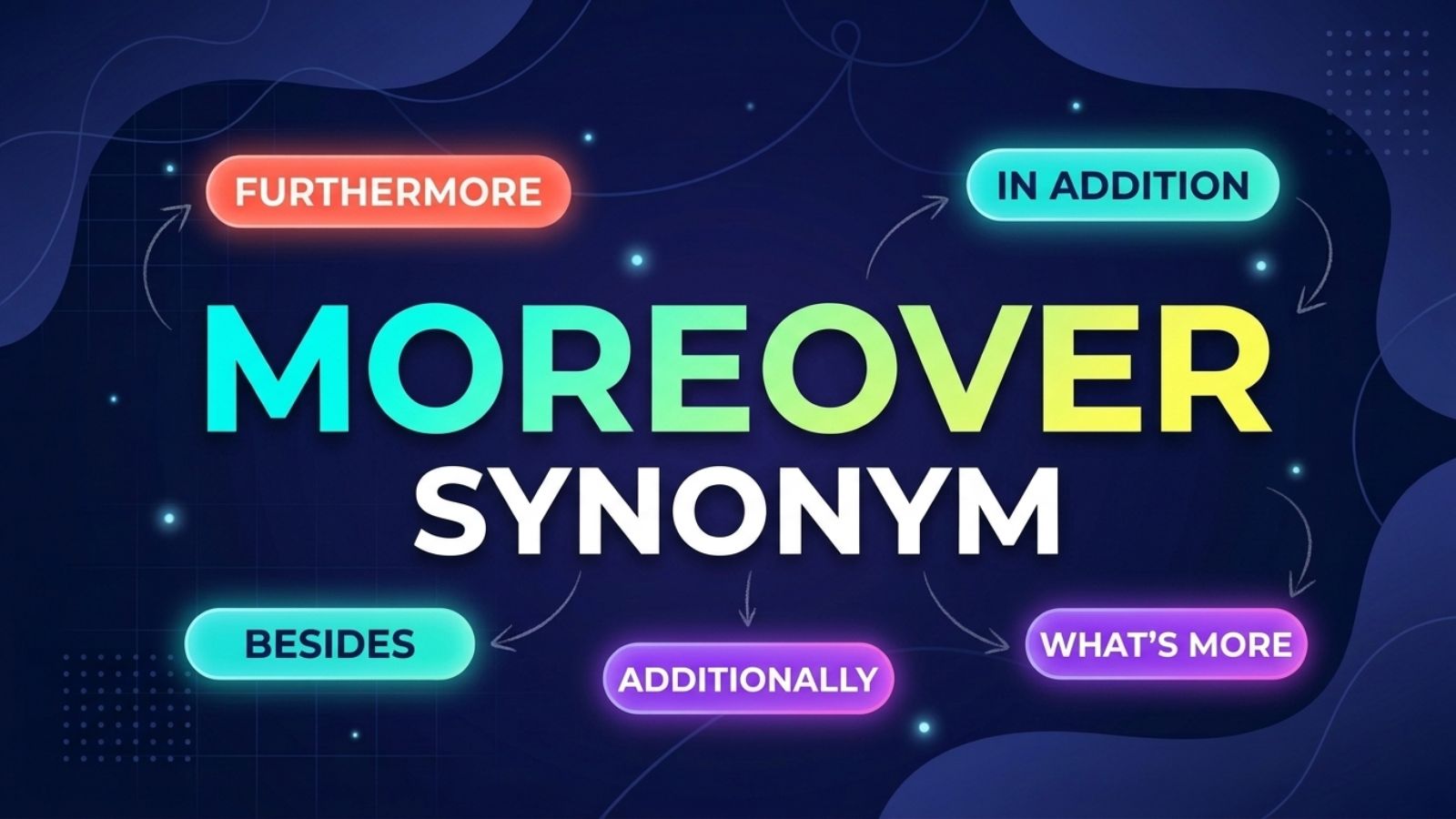
Choosing the right moreover synonym can make your writing sound more natural, professional, and engaging. Moreover is a formal transition word used to add information that supports or strengthens a previous statement. However, repeating it too often can make an essay, report, or email feel monotonous. Alternatives such as furthermore, additionally, in addition, and also can help you express the same general idea while adjusting the tone and flow of your writing.
In this guide, you will discover the best synonyms for moreover, their meanings, example sentences, and differences in usage. You will also learn which alternatives work best in academic essays, professional communication, and everyday English.
What Does Moreover Mean?
Moreover is an adverb that means in addition to what has already been stated or furthermore. It introduces another point that adds information, strengthens an argument, or supports an existing idea.
In simple English, moreover means “also, and another important thing is.”
The word is commonly used in formal writing, academic essays, business reports, presentations, and persuasive arguments.
Examples:
- The software is easy to use. Moreover, it is affordable.
- The candidate has extensive experience. Moreover, she possesses excellent communication skills.
- The library offers free access to books. Moreover, students can use its online resources.
In each sentence, moreover introduces additional information that supports or develops the previous statement.
Part of speech: Adverb
Tone: Formal, academic, and professional
25+ Best Synonyms for Moreover
The best alternative depends on your sentence, intended meaning, and writing style. Some words closely match moreover, while others work only in particular contexts.
Here are useful alternatives to consider.
1. Furthermore
Meaning: In addition to what has already been said, often introducing another supporting point.
Furthermore is one of the closest synonyms for moreover. It works particularly well in academic writing, formal arguments, and professional reports.
Example: The proposed policy will reduce operating costs. Furthermore, it will improve workplace efficiency.
Best for: Academic essays, reports, and formal arguments.
2. Additionally
Meaning: Used to introduce another fact, point, or item of information.
Additionally is a clear, professional alternative to moreover. It is especially useful when adding another detail without emphasizing the strength of the argument.
Example: The course includes practical exercises. Additionally, students receive access to recorded lessons.
Best for: Business writing, instructions, and informative articles.
3. In Addition
Meaning: As another point or item to consider.
In addition is a versatile phrase that works in formal and neutral writing. It can introduce supporting evidence, another benefit, or an extra consideration.
Example: The apartment is close to public transportation. In addition, it has a spacious kitchen.
Best for: Essays, descriptions, and professional communication.
4. Also
Meaning: In addition to something already mentioned.
Also is a simple, natural alternative that works in everyday conversations and most forms of writing. It is generally less formal than moreover.
Example: The new app saves time. It also helps users organize their tasks.
Best for: Everyday English, emails, and general writing.
5. Besides
Meaning: In addition to something; sometimes used to introduce another reason or consideration.
Besides can strengthen an argument by adding another reason. Depending on the context, it may sound conversational rather than strictly formal.
Example: We should consider the proposal. Besides, it could save the company money.
Best for: Conversations, informal arguments, and persuasive writing.
6. What Is More
Meaning: Used to introduce an additional point that reinforces what was just said.
What is more often emphasizes the importance or surprising nature of the next point.
Example: The hotel offers comfortable rooms. What is more, breakfast is included.
Best for: Persuasive writing and engaging descriptions.
7. On Top of That
Meaning: In addition to something already mentioned.
This conversational phrase is useful when adding another benefit, problem, or circumstance. It is less formal than moreover.
Example: The train was delayed. On top of that, we had to change platforms.
Best for: Informal writing, storytelling, and conversation.
8. As Well
Meaning: In addition; too.
As well is a natural alternative when adding a person, feature, action, or fact. It usually appears at the end of a clause or sentence.
Example: The program teaches grammar and vocabulary. It improves pronunciation as well.
Best for: Everyday communication and neutral writing.
9. Too
Meaning: Also or in addition.
Too is a short, informal-to-neutral alternative. It usually appears near the end of a clause or sentence.
Example: The manager approved the budget. The finance team agreed too.
Best for: Conversations, emails, and straightforward writing.
10. Likewise
Meaning: In the same way; similarly.
Likewise is not a direct synonym in every context. It works when the next statement describes a similar situation, action, or characteristic.
Example: The first department reduced its expenses. Likewise, the second department adopted a more economical approach.
Best for: Comparisons and discussions of similar situations.
11. Similarly
Meaning: In a similar way or manner.
Similarly introduces a parallel point rather than simply adding any unrelated detail.
Example: The first study found improved reading skills. Similarly, the second study reported better comprehension.
Best for: Academic writing, comparisons, and analytical discussions.
12. Plus
Meaning: Also or in addition.
Plus is an informal alternative that can introduce another reason, advantage, or consideration.
Example: The phone has a long battery life. Plus, it charges quickly.
Best for: Casual communication, marketing copy, and informal writing.
13. Beyond That
Meaning: In addition to the point already mentioned.
Beyond that suggests moving past one consideration to discuss another. It is useful when the additional point expands the discussion.
Example: The team completed the initial design. Beyond that, it developed a detailed testing plan.
Best for: Explanatory writing and discussions of next steps.
14. More Importantly
Meaning: Introducing a point considered more significant than the previous one.
This phrase does more than add information: it establishes a hierarchy of importance.
Example: The treatment is affordable. More importantly, it has been shown to be effective.
Best for: Persuasive writing and prioritizing arguments.
15. Equally Important
Meaning: Introducing another point that deserves the same level of attention.
Use this phrase when two considerations are similarly significant.
Example: The proposal reduces costs. Equally important, it protects the quality of the service.
Best for: Formal reports, academic writing, and balanced arguments.
16. Not Only That
Meaning: Introducing another point that adds emphasis to a previous statement.
This expression often makes writing more conversational and highlights an additional advantage or problem.
Example: The workshop improved our technical skills. Not only that, it helped us build stronger professional relationships.
Best for: Speeches, informal writing, and persuasive explanations.
17. Coupled With That
Meaning: Together with the previously mentioned fact or circumstance.
This expression is useful when two factors combine to create a result or strengthen an argument.
Example: Strong customer demand, coupled with lower production costs, improved the company’s outlook.
Best for: Business reports and analytical writing.
18. Along With That
Meaning: In addition to the thing already mentioned.
Along with that works when discussing an additional feature, responsibility, benefit, or circumstance.
Example: The position offers flexible hours. Along with that, employees receive professional development opportunities.
Best for: Workplace communication and informal explanations.
19. Added to That
Meaning: Used to introduce another factor or consideration.
This phrase can emphasize how an additional circumstance contributes to an overall situation.
Example: The roads were flooded. Added to that, heavy traffic made the journey even longer.
Best for: Conversational explanations and descriptive writing.
20. Further
Meaning: To a greater extent or additionally, depending on the sentence.
Further can introduce additional information in expressions such as further evidence or furthermore. It does not always replace moreover naturally.
Example: Further investigation revealed several errors in the original report.
Best for: Academic, technical, and professional writing.
21. Additionally to This
Meaning: Intended to express the idea of adding another point.
Although the meaning is understandable, “additionally to this” is generally awkward and unnecessary in standard English. Prefer additionally, in addition, or in addition to this.
Example: In addition to this, the company provides free training.
Best for: Replacing awkward transitions with natural English.
22. To Add to That
Meaning: Used to introduce another detail that contributes to an existing situation.
This expression is particularly natural when adding another difficulty, benefit, or development.
Example: The deadline was approaching. To add to that, two team members were absent.
Best for: Informal explanations and storytelling.
23. As an Added Benefit
Meaning: Introducing an additional advantage.
This phrase is more specific than moreover because it signals a positive extra feature.
Example: The subscription includes cloud storage. As an added benefit, users receive priority support.
Best for: Product descriptions, business writing, and promotional content.
24. Another Point Is
Meaning: Introducing an additional argument or consideration.
This phrase makes the structure of an explanation explicit, helping readers follow several points.
Example: The plan is affordable. Another point is that it can be implemented quickly.
Best for: Essays, presentations, and explanatory writing.
25. Additionally, It Is Worth Noting That
Meaning: Introducing a further detail that deserves attention.
This longer phrase is useful when introducing an important qualification or supporting fact. However, it can make simple writing unnecessarily wordy.
Example: Additionally, it is worth noting that the figures represent estimates rather than confirmed totals.
Best for: Formal reports and careful explanations.
26. Indeed
Meaning: Used to emphasize or confirm a statement, sometimes adding supporting information.
Indeed is not a general synonym for moreover. It works when the following statement reinforces, confirms, or intensifies an earlier point.
Example: The project was challenging. Indeed, it required several months of careful planning.
Best for: Formal arguments and emphatic writing.
Best Synonyms for Moreover by Context
Different alternatives suit different types of writing. Use the following table to choose one that matches your purpose.
| Context | Best alternative | Example |
|---|---|---|
| Academic essays | Furthermore | Furthermore, the evidence supports the hypothesis. |
| Research papers | Additionally | Additionally, the results reveal a clear pattern. |
| Business reports | In addition | In addition, operating expenses declined. |
| Everyday writing | Also | The update also fixes several bugs. |
| Persuasive arguments | What is more | What is more, the plan is affordable. |
| Informal conversation | Plus | Plus, we have enough time. |
| Comparing similar findings | Similarly | Similarly, the second experiment produced positive results. |
| Emphasizing importance | More importantly | More importantly, the approach protects users. |
| Adding another benefit | As an added benefit | As an added benefit, delivery is free. |
| Confirming a point | Indeed | Indeed, the figures support this conclusion. |
Remember that these alternatives are not interchangeable in every sentence. The best choice depends on whether you are adding information, comparing ideas, emphasizing importance, or confirming a previous statement.
Formal Synonyms for Moreover
In academic and professional writing, choose transitions that make relationships between ideas clear without sounding unnecessarily complicated.
The strongest formal alternatives include:
- Furthermore: Adds another point supporting the previous statement.
- Additionally: Introduces extra information in a direct, neutral way.
- In addition: Works well for introducing another consideration.
- What is more: Adds an emphatic supporting point.
- Equally important: Highlights a point of comparable significance.
- More importantly: Signals that the next point deserves greater attention.
Example in academic writing:
Original: The survey revealed a high level of customer satisfaction. Moreover, respondents appreciated the speed of the service.
Alternative: The survey revealed a high level of customer satisfaction. Furthermore, respondents appreciated the speed of the service.
Both versions are grammatically correct and communicate an additional supporting point.
However, avoid replacing moreover with a more elaborate phrase merely to sound academic. Clear, direct transitions usually make a stronger impression than unnecessarily complicated language.
Informal Alternatives to Moreover
Moreover can sound overly formal in casual conversation, text messages, and friendly emails. In these settings, shorter alternatives are often more natural.
Consider these options:
- Also: “I finished the assignment. I also checked the references.”
- Plus: “The café is nearby. Plus, it has free Wi-Fi.”
- Besides: “We should leave now. Besides, the roads may get busy.”
- On top of that: “The bus was late. On top of that, it started raining.”
- Too: “She wants to join the team too.”
- As well: “You can download the document as well.”
These expressions vary slightly in meaning and tone. For example, besides often introduces an additional reason, while plus can make a new point sound casual and conversational.
How to Use Moreover in a Sentence
Moreover usually connects an additional statement to an earlier idea. It is particularly useful when the second statement supports, strengthens, or expands the first.
1. At the beginning of a sentence
Place a comma after moreover when it introduces a sentence.
Example: The school provides excellent learning facilities. Moreover, it offers free tutoring sessions.
This structure is common in academic essays, reports, and formal explanations.
2. Within a sentence
Moreover can appear after the subject or another introductory element when the sentence structure allows it.
Example: The proposal, moreover, addresses several concerns raised by employees.
The commas set off moreover as a parenthetical transition.
3. When adding supporting evidence
Use moreover to introduce another fact that reinforces the main argument.
Example: Regular exercise improves physical fitness. Moreover, it can support better sleep and overall well-being.
The second sentence expands the argument by providing another relevant benefit.
4. When adding another reason
Moreover can introduce an additional reason for supporting a decision or conclusion.
Example: We should revise the policy because it is outdated. Moreover, several of its requirements are difficult to implement.
The second statement strengthens the case for revising the policy.
Moreover vs. Furthermore vs. Additionally
These three transitions are closely related, but their emphasis can differ slightly.
| Word | Main function | Typical tone |
|---|---|---|
| Moreover | Adds a point that often strengthens an argument | Formal |
| Furthermore | Adds another supporting or developing point | Formal |
| Additionally | Introduces extra information | Neutral to formal |
In many sentences, moreover and furthermore are interchangeable. Additionally is also often suitable, particularly when you want to add information without emphasizing an argument.
Compare these examples:
- The product is affordable. Moreover, it is durable.
- The product is affordable. Furthermore, it is durable.
- The product is affordable. Additionally, it comes with a two-year warranty.
The first two examples highlight an additional supporting quality. The third introduces another piece of information, although all three transitions can work in suitable contexts.
Common Mistakes When Using Moreover
Even advanced English learners can misuse transition words. Avoid these common errors.
Mistake 1: Using moreover without a logical connection
❌ The weather was sunny. Moreover, the book contained twelve chapters.
✅ The weather was sunny. Moreover, it was warm enough for a picnic.
The incorrect example connects two unrelated ideas. Moreover works best when the second statement meaningfully develops or supports the first.
Mistake 2: Using moreover in place of however
❌ The plan is expensive. Moreover, we cannot afford it.
✅ The plan is expensive. Moreover, it requires additional maintenance.
✅ The plan is expensive. However, we can afford it.
Moreover adds information, while however introduces contrast. Choose the transition that reflects the relationship between your ideas.
Mistake 3: Using unnecessary punctuation
❌ The service is reliable moreover it is affordable.
✅ The service is reliable. Moreover, it is affordable.
Alternatively, you can use a semicolon:
✅ The service is reliable; moreover, it is affordable.
When moreover connects two independent clauses within one sentence, a semicolon before it and a comma after it are appropriate.
Mistake 4: Repeating moreover too often
❌ Moreover, the system is fast. Moreover, it is secure. Moreover, it is affordable.
✅ The system is fast. Furthermore, it is secure. Additionally, it is affordable.
Varying transitions can improve readability, but do not replace every occurrence mechanically. Sometimes a simple conjunction or a revised sentence is more natural.
Frequently Asked Questions
1. What is the best synonym for moreover?
Furthermore is one of the closest synonyms for moreover, especially in formal and academic writing. Additionally and in addition are also excellent choices when introducing another fact or supporting point.
2. What is a simple word for moreover?
Also is one of the simplest alternatives. It communicates the idea of adding information without the formal tone associated with moreover. Too and as well can also work in suitable sentence structures.
3. Is moreover formal or informal?
Moreover is generally considered formal. It appears frequently in academic essays, professional reports, and structured arguments. In casual conversation, also, plus, and besides often sound more natural.
4. Can I use furthermore and moreover interchangeably?
Yes, in many contexts. Both words introduce additional information and often strengthen an argument. However, the most natural choice depends on the sentence, emphasis, and writing style.
5. What is the difference between moreover and however?
Moreover adds information that develops or supports a previous point. However introduces a contrast or qualification. For example, “The phone is affordable. Moreover, it is durable” adds a benefit, while “The phone is affordable. However, its battery life is short” introduces a drawback.
6. What is the opposite of moreover?
Moreover does not have one exact antonym because it is a transitional adverb rather than a word describing a single quality. However, nevertheless, and conversely can introduce contrasting relationships in certain contexts, but they are not direct antonyms of moreover.
Conclusion
The best moreover synonym depends on your audience, writing style, and the relationship between your ideas. Furthermore, additionally, and in addition are strong choices for formal writing, while also, plus, and as well work well in everyday communication. Use more importantly when highlighting a greater priority, and similarly when comparing parallel situations.
Rather than choosing a synonym simply to avoid repetition, focus on meaning and clarity. A well-chosen transition helps readers understand how each point connects to the next and makes your writing more effective.