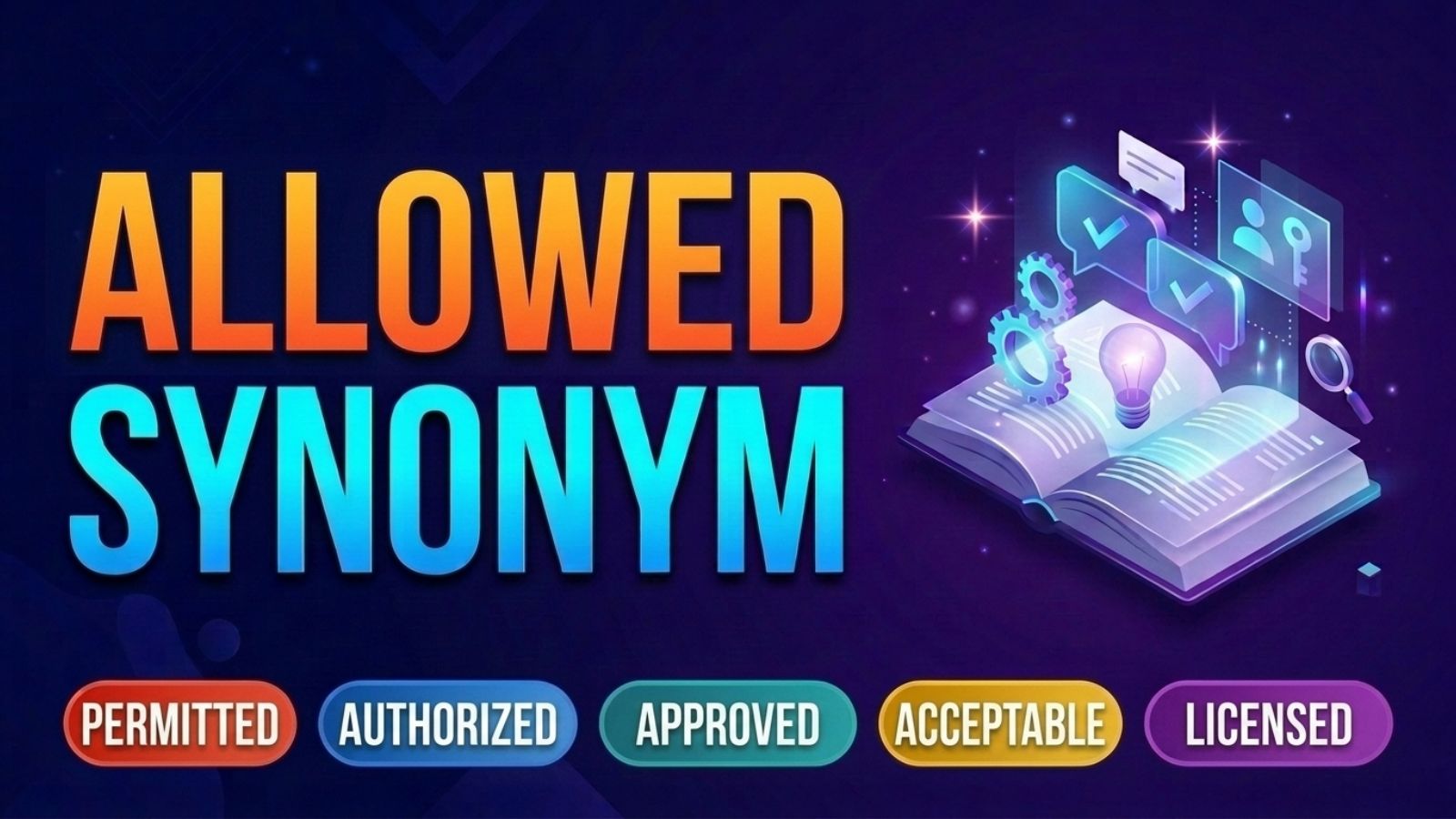
The phrase “allowed synonym” usually refers to another word for allowed, meaning permitted, acceptable, or authorized. The best alternative depends on the situation. For example, permitted works well in everyday English, authorized suits official situations, and acceptable describes something considered suitable or satisfactory.
Whether you are writing an academic assignment, explaining a rule, preparing a professional email, or improving your vocabulary, choosing the right synonym can make your message clearer. Some alternatives emphasize permission, while others suggest approval, eligibility, or freedom to act. This guide explains the most useful synonyms for allowed, provides natural example sentences, and shows you how to choose the right word for your context.
What Does “Allowed” Mean?
Allowed means permitted to happen, be done, or be used. It indicates that a person has permission or that a particular action does not break an applicable rule.
- Part of speech: Verb (past tense and past participle of allow); also an adjective in some contexts.
- Simple meaning: Something is permitted or someone has permission to do something.
- Opposite: Forbidden, prohibited, or disallowed.
Examples:
- Students are allowed to use calculators during the examination.
- Only authorized employees are allowed inside the laboratory.
- Photography is allowed in the museum’s public areas.
In these examples, allowed indicates that an action is permitted under particular conditions.
25 Best Synonyms for Allowed
The following alternatives are useful in different situations. Although many are close synonyms, they are not interchangeable in every sentence.
1. Permitted
Meaning: Officially or generally allowed under a rule or arrangement.
Example: Visitors are permitted to enter the garden after 9 a.m.
Best for: Everyday communication, school rules, policies, and instructions.
2. Authorized
Meaning: Given official permission or power to do something.
Example: Only authorized personnel may access these records.
Best for: Workplace procedures, security, and official documents.
3. Approved
Meaning: Accepted or formally agreed to by someone with the authority to decide.
Example: The manager approved the requested schedule change.
Best for: Applications, proposals, requests, and plans.
Difference: Something can be approved without being immediately permitted in every circumstance.
4. Acceptable
Meaning: Considered satisfactory, suitable, or allowed according to particular standards.
Example: Late submissions are acceptable only with prior approval.
Best for: Academic writing, professional standards, and guidelines.
5. Legal
Meaning: Permitted by law.
Example: The activity is legal in this jurisdiction.
Best for: Laws, regulations, and legal discussions.
Difference: Legal specifically concerns the law, while allowed can refer to informal permission or private rules.
6. Permissible
Meaning: Allowed under a rule, law, policy, or established standard.
Example: The policy explains which expenses are permissible.
Best for: Formal, academic, and administrative writing.
7. Authorized by
Meaning: Officially permitted by a person, organization, or governing body.
Example: The changes were authorized by the department head.
Best for: Formal statements identifying who granted permission.
8. Sanctioned
Meaning: Officially approved or authorized.
Example: The association organized a sanctioned competition.
Best for: Official events, competitions, and institutional activities.
Caution: Sanctioned can also mean penalized, depending on context, so use it carefully.
9. Approved of
Meaning: Regarded favorably or considered acceptable.
Example: Her supervisor approved of the proposed approach.
Best for: Expressing agreement or a positive judgment.
Difference: Approved of usually expresses a favorable opinion rather than formal permission.
10. Granted
Meaning: Given or formally provided, often referring to permission, a request, or a right.
Example: The student was granted permission to leave early.
Best for: Describing permission that has been given.
11. Admissible
Meaning: Acceptable or permitted within a particular process, especially a legal proceeding.
Example: The judge decided that the evidence was admissible.
Best for: Legal discussions, formal procedures, and evidence.
12. Eligible
Meaning: Meeting the requirements to receive or do something.
Example: Applicants aged eighteen or older are eligible to participate.
Best for: Applications, benefits, competitions, and qualifications.
Difference: Eligibility means meeting the conditions; it does not always guarantee permission or approval.
13. Valid
Meaning: Legally, officially, or logically acceptable under relevant requirements.
Example: A valid ticket is required to enter the venue.
Best for: Tickets, permissions, documents, and official requirements.
14. Tolerated
Meaning: Allowed to continue, even if it is not particularly liked or approved.
Example: Occasional minor errors may be tolerated during training.
Best for: Situations involving flexibility or limited acceptance.
Difference: Something tolerated is not necessarily encouraged or formally approved.
15. Accepted
Meaning: Received favorably or regarded as suitable.
Example: The organization accepted her application.
Best for: Applications, proposals, offers, and submissions.
Difference: Acceptance often describes a decision, not simply permission to act.
16. Allowed to
Meaning: Given permission or freedom to perform a particular action.
Example: Employees are allowed to work remotely twice a week.
Best for: Direct, natural sentences about permission.
This is the original expression rather than a replacement word, but it is often the clearest option.
17. Free to
Meaning: Able to act without a particular restriction or obligation.
Example: You are free to choose whichever topic interests you.
Best for: Informal conversations, personal choices, and expressing freedom.
18. Entitled to
Meaning: Having a recognized right to receive or do something.
Example: Eligible customers are entitled to a refund under the policy.
Best for: Rights, benefits, agreements, and formal explanations.
Difference: Being entitled to something means having a right to it, not merely receiving permission.
19. Cleared
Meaning: Given permission to proceed after a check or review.
Example: The technician was cleared to operate the equipment.
Best for: Safety procedures, security checks, and professional settings.
20. Exempt
Meaning: Not required to follow a particular rule or obligation.
Example: Some students are exempt from the language requirement.
Best for: Rules, fees, requirements, and formal exceptions.
Difference: Exempt means excused from an obligation, not generally allowed to do something.
21. Within the Rules
Meaning: Consistent with the applicable rules or requirements.
Example: Her use of the reference material was within the rules.
Best for: Sports, school policies, workplace procedures, and competitions.
22. Acceptable Under the Rules
Meaning: Permitted or considered satisfactory according to established requirements.
Example: This method is acceptable under the current guidelines.
Best for: Academic assignments, compliance, and policy explanations.
23. Authorized for Use
Meaning: Officially approved for a specific purpose.
Example: This software is authorized for use on company devices.
Best for: Technology, business policies, and security instructions.
24. Open to
Meaning: Available for participation, consideration, or use.
Example: The workshop is open to students from every department.
Best for: Events, opportunities, applications, and participation.
Difference: Open to describes availability or access, which may still be subject to conditions.
25. Unrestricted
Meaning: Not subject to a particular limitation or restriction.
Example: Members have unrestricted access to the public reading room.
Best for: Access, permissions, and descriptions of freedom from limitations.
Caution: Use unrestricted only when the relevant freedom is genuinely broad; it can imply fewer limitations than allowed.
Synonyms for Allowed by Context
The most effective synonym depends on what you want to communicate. Use the following groups to choose an alternative that fits your sentence.
Common and Everyday Synonyms
These words work well in ordinary conversations and straightforward writing.
- Permitted: You are permitted to bring one guest.
- Acceptable: Your suggested alternative is acceptable.
- Free to: You are free to leave whenever you finish.
- Accepted: Your application has been accepted.
- Allowed to: Children are allowed to play in the park.
For most everyday situations, permitted is the closest direct alternative to allowed.
Formal and Academic Synonyms
For essays, reports, policies, and professional communication, choose more precise vocabulary.
- Permissible: Only permissible expenses will be reimbursed.
- Authorized: Authorized representatives may sign the document.
- Admissible: The evidence was deemed admissible.
- Approved: The committee approved the revised proposal.
- Granted: Permission was granted after the review.
These words sound formal because they often refer to established procedures, decisions, or standards.
Legal and Official Synonyms
When discussing laws, contracts, regulations, or institutional requirements, precision matters.
- Legal: The transaction is legal under applicable law.
- Lawful: The officer acted in a lawful manner.
- Authorized: The official was authorized to issue the permit.
- Permissible: The action is permissible under the regulation.
- Entitled to: The employee is entitled to statutory leave.
Legal and lawful relate specifically to the law. Authorized concerns permission from someone or an organization with the relevant authority. These meanings overlap but are not identical.
Synonyms That Express Approval
Sometimes allowed refers to a decision rather than a general rule. In such cases, these alternatives may be more accurate.
- Approved: The request was approved.
- Accepted: The proposal was accepted.
- Sanctioned: The event was officially sanctioned.
- Granted: The extension was granted.
- Cleared: The plan was cleared for implementation.
Choose approved when someone agrees to a request, accepted when something is received favorably, and granted when permission or a request is formally given.
Quick Comparison Table
| Synonym | Main meaning | Typical context |
|---|---|---|
| Permitted | Allowed | Everyday rules |
| Authorized | Officially given permission | Security and work |
| Approved | Formally accepted | Requests and proposals |
| Acceptable | Suitable or satisfactory | Standards and guidelines |
| Legal | Permitted by law | Legal matters |
| Permissible | Allowed under a rule | Formal writing |
| Eligible | Meets the requirements | Applications and benefits |
| Admissible | Accepted under procedural rules | Legal proceedings |
| Tolerated | Allowed despite reservations | Behavior and exceptions |
| Entitled to | Has a recognized right | Benefits and agreements |
| Exempt | Excused from a requirement | Rules and obligations |
| Unrestricted | Free from a limitation | Access and permissions |
Remember that these words describe different aspects of permission. Select one based on the precise meaning you need rather than replacing allowed mechanically.
How to Use “Allowed” in a Sentence
The word allowed commonly appears in three sentence patterns.
1. Allowed + Object
Use this pattern when someone permits an action or gives something permission.
Structure: Subject + allow + object + infinitive.
Examples:
- The teacher allowed the students to leave early.
- My parents allowed me to attend the event.
- The manager allowed the team to revise the deadline.
In these sentences, allowed describes an action performed by the person granting permission.
2. Be Allowed to + Verb
Use this passive construction when the focus is on the person receiving permission.
Structure: Subject + be + allowed + to + base verb.
Examples:
- Visitors are allowed to take photographs.
- We were allowed to use our notes.
- She will be allowed to participate next year.
This pattern is especially common when explaining rules, restrictions, and personal permissions.
3. Be Allowed + Noun or Activity
Use allowed with a noun or an activity to describe what a rule permits.
Examples:
- Mobile phones are allowed in the waiting area.
- Outside food is not allowed.
- Only registered vehicles are allowed on the premises.
The passive adjective-like use of allowed is particularly common in signs, instructions, and policies.
Common Mistakes When Choosing Synonyms for Allowed
Some alternatives sound similar but communicate different meanings. Avoid these common errors.
Mistake 1: Confusing Permission With Approval
Incorrect: My supervisor permitted the proposal.
Better: My supervisor approved the proposal.
Why? A proposal is normally approved or rejected. Permitted is more natural when referring to an action someone may perform.
Mistake 2: Using Legal When You Mean Acceptable
Incorrect: Your informal writing style is legal for this assignment.
Better: Your informal writing style is acceptable for this assignment.
Why? Legal concerns the law. Acceptable describes whether something meets a standard or requirement.
Mistake 3: Confusing Eligibility With Permission
Incorrect: She is eligible to enter, so the organizer has already given her permission.
Better: She is eligible to enter, but she still needs confirmation from the organizer.
Why? Meeting entry requirements does not always mean that permission has been granted.
Mistake 4: Using Unrestricted When Restrictions Still Apply
Incorrect: Employees have unrestricted access to the office, but only during business hours.
Better: Employees have access to the office during business hours.
Why? Unrestricted suggests that the access is not limited in the relevant respect. If specific limits apply, describe them directly.
What Is the Opposite of Allowed?
The best antonym depends on the situation.
- Forbidden: Explicitly not permitted. Example: Parking is forbidden in this area.
- Prohibited: Officially banned by a rule or law. Example: Smoking is prohibited inside the building.
- Disallowed: Not permitted under a particular rule. Example: Disallowed entries will be removed.
- Restricted: Limited by specific conditions. Example: Access is restricted to staff members.
- Banned: Officially prevented or prohibited. Example: The device was banned from the competition.
- Unauthorized: Not approved or permitted by the appropriate authority. Example: Unauthorized access is prohibited.
Forbidden and prohibited are strong opposites of allowed. However, restricted usually means permission exists only under certain conditions, rather than being completely absent.
Frequently Asked Questions
1. What is the closest synonym for allowed?
Permitted is usually the closest synonym for allowed. Both indicate that an action is acceptable under a rule or with someone’s permission. For formal situations, authorized or permissible may be more suitable.
2. What is a formal word for allowed?
Permissible, authorized, and admissible are useful formal alternatives. Choose permissible for actions permitted under rules, authorized for permission granted by an authority, and admissible for something accepted within a specific process.
3. Is allowed the same as approved?
No. Allowed means permitted, while approved means accepted or formally agreed to. For example, a general policy may allow flexible working, but an employee’s specific request may still need approval.
4. What is the difference between allowed and permissible?
Both words indicate that something is permitted. Allowed is more common in everyday English, while permissible often sounds more formal and is frequently used in rules, policies, and academic or professional writing.
5. What is the opposite of allowed?
Common antonyms include forbidden, prohibited, and disallowed. Use restricted when an activity is permitted only under certain conditions, and unauthorized when the required permission has not been granted.
6. Can I use allowed in academic writing?
Yes. Allowed is grammatically correct and suitable for academic writing. However, permitted, permissible, or authorized may be more precise when discussing formal rules, research procedures, institutional policies, or official permissions.
Conclusion
The best synonyms for allowed include permitted, authorized, approved, acceptable, and permissible. Each word emphasizes a slightly different aspect of permission, approval, or suitability. Use permitted for general rules, authorized for official permission, approved for accepted requests, and legal when discussing what the law allows. Remember that words such as eligible, exempt, and unrestricted have narrower meanings and are not direct replacements in every sentence. By considering context, tone, and grammatical structure, you can choose the most accurate alternative and communicate your meaning clearly.