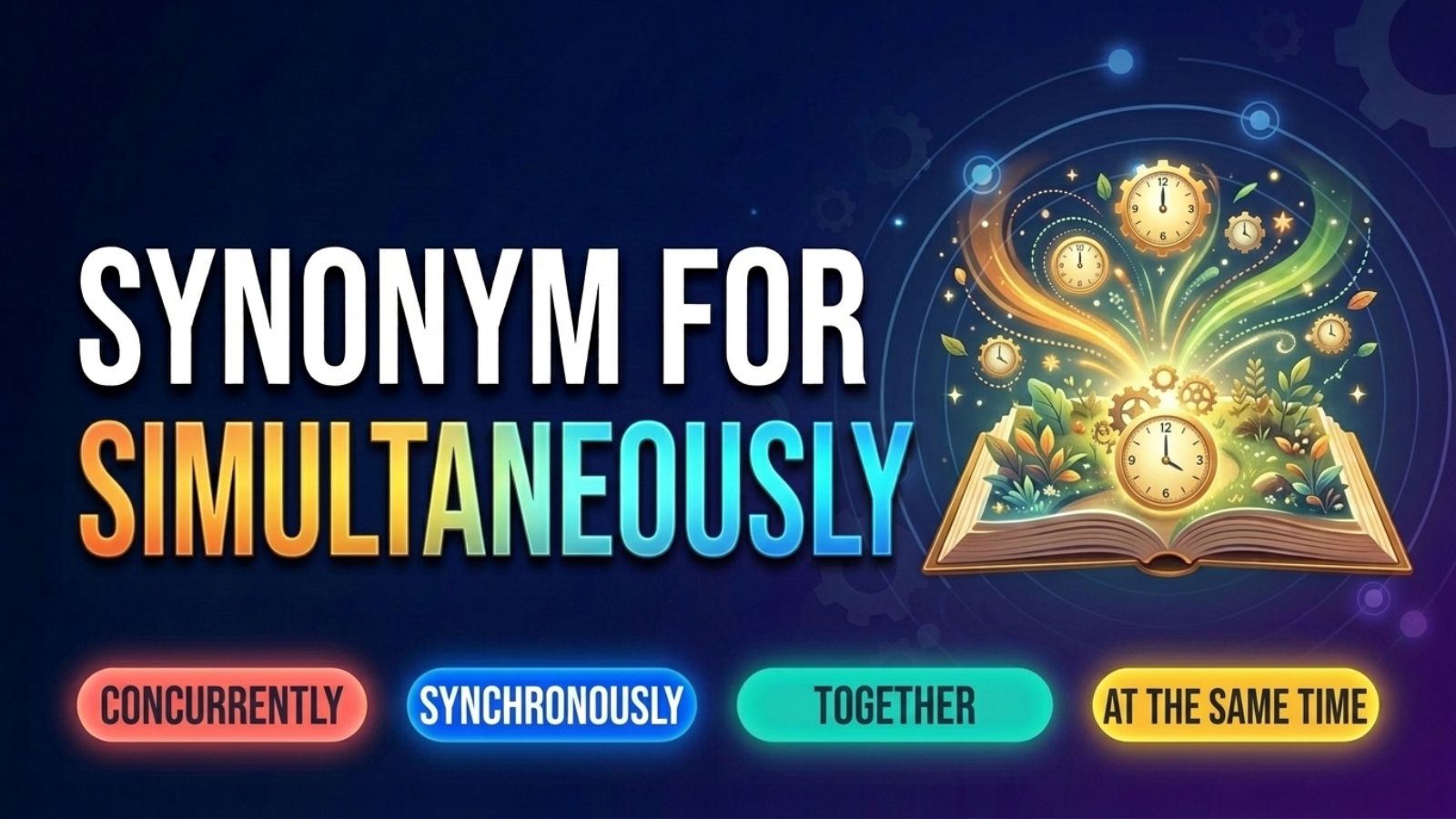
If you need a synonym for simultaneously, the best alternatives include at the same time, concurrently, together, in parallel, synchronously, and at once. However, these expressions are not interchangeable in every sentence. Some work best in formal or academic writing, while others sound more natural in everyday conversation. Choosing the right alternative depends on whether you mean two events happening at the same moment, activities occurring during the same period, or processes running alongside each other. This guide explains the most useful synonyms for simultaneously, shows how to use them in sentences, and highlights the differences that matter when writing clearly.
What Does Simultaneously Mean?
Simultaneously is an adverb that means two or more actions or events happen at the same time or during the same moment.
In simple English, if things happen simultaneously, they happen together rather than one after another.
Examples:
- The audience simultaneously applauded the performers.
- She can listen to music and study simultaneously.
- Two alarms went off simultaneously.
- The company launched its products simultaneously in three countries.
The word is useful in academic writing, business communication, news reports, scientific explanations, and everyday conversation. It emphasizes the timing of events rather than necessarily suggesting that they are connected.
Best Synonyms for Simultaneously
These alternatives cover the most common situations in which you might use simultaneously. Each has a slightly different meaning or level of formality.
1. At the Same Time
Meaning: Two or more things happen during the same moment or period.
This is the clearest, most natural alternative for everyday English. It works in both speaking and writing.
Example: The students completed the assignment at the same time.
2. Concurrently
Meaning: Two or more events or activities occur during overlapping periods.
This formal alternative is common in academic, technical, legal, and professional writing. It does not always mean that events begin and end at precisely the same moment.
Example: The researchers conducted two studies concurrently.
3. Together
Meaning: Two or more people or things act or occur jointly.
Use together when the emphasis is on participation or joint action, rather than exact timing.
Example: The musicians performed together on stage.
4. In Parallel
Meaning: Two or more activities or processes proceed alongside one another.
This expression is especially useful in computing, project management, engineering, and business.
Example: The development and testing teams worked in parallel.
5. At Once
Meaning: At the same moment, or immediately, depending on context.
At once can replace simultaneously when it refers to timing. However, it can also mean “immediately,” so the intended meaning should be clear.
Example: The lights went out at once.
6. Synchronously
Meaning: Actions occur in a coordinated manner, often according to the same timing.
This technical term appears in computing, communications, engineering, and discussions of coordinated movement.
Example: The devices updated their clocks synchronously.
7. In Unison
Meaning: People or things act, speak, or produce sounds together in coordination.
This phrase is particularly appropriate for groups responding or performing together.
Example: The children answered the teacher in unison.
8. Side by Side
Meaning: Things happen or progress alongside each other.
This phrase can describe simultaneous activities, but it may also refer to physical position or cooperation.
Example: The two teams worked side by side on the project.
9. At the Same Moment
Meaning: Events occur at precisely the same point in time.
This expression is useful when exact timing matters.
Example: Both runners crossed the finish line at the same moment.
10. Coincidentally
Meaning: Events happen at the same time by chance, or their timing happens to coincide.
This is a context-specific alternative, not a direct synonym in every sentence. It adds the idea of coincidence.
Example: We arrived at the station coincidentally, without planning to meet.
11. In Tandem
Meaning: Two or more people or processes work together in a coordinated way.
It often suggests cooperation or complementary activity rather than merely identical timing.
Example: The marketing and sales departments worked in tandem.
12. Concurrently With
Meaning: During the same period as another event or activity.
This construction is useful in formal writing when identifying overlapping activities.
Example: The training program ran concurrently with the new employee orientation.
13. In Coordination
Meaning: Activities happen according to an organized plan or coordinated arrangement.
This phrase emphasizes planning and cooperation, so it is not suitable for every instance of simultaneous action.
Example: The emergency teams responded in coordination with local authorities.
14. All at Once
Meaning: Several things happen at the same time, sometimes unexpectedly or suddenly.
This expression is natural in conversation and descriptive writing.
Example: Everyone started talking all at once.
15. In Parallel With
Meaning: One activity proceeds alongside another during an overlapping period.
This is useful in technical and professional contexts.
Example: The company developed its mobile application in parallel with its website.
16. Jointly
Meaning: Two or more people or organizations do something together or share responsibility for it.
Jointly emphasizes shared action, not necessarily exact timing.
Example: The universities jointly organized the conference.
17. Collectively
Meaning: People or things act or are considered as a group.
This term emphasizes a group effort or combined effect rather than precise simultaneity.
Example: The team collectively approved the proposal.
18. In Sync
Meaning: Actions, movements, or processes happen in harmony or with matching timing.
This informal expression is common in everyday speech and creative writing.
Example: The dancers moved in sync with the music.
19. At the Same Time as
Meaning: During the same moment or period as another event.
This phrase is useful for connecting two events directly in a sentence.
Example: The announcement was released at the same time as the report.
20. Side by Side in Time
Meaning: Two activities occur during overlapping periods.
This is an explanatory phrase rather than a standard, direct synonym. In most cases, concurrently or in parallel sounds more natural.
Example: The two processes operated during overlapping periods.
21. Simultaneously With
Meaning: Occurring at the same time as something else.
This construction can work in formal descriptions, although at the same time as is often easier to read.
Example: The new policy took effect simultaneously with the revised regulations.
22. In the Same Instant
Meaning: At precisely the same instant.
This expression is useful in narrative, descriptive, and scientific contexts where exact timing is important.
Example: In the same instant, both doors swung open.
23. Together at the Same Time
Meaning: Two or more actions occur jointly and during the same period.
This phrase can be useful for clarity, but it may be redundant because together already suggests joint action.
Example: The group sang together at the same time.
24. In Step
Meaning: Moving or progressing in a coordinated rhythm or manner.
It is suitable for synchronized movement or coordinated progress, not every simultaneous event.
Example: The marching band moved in step.
25. During the Same Period
Meaning: Two or more activities take place within an overlapping time frame.
This is especially helpful when events last for minutes, hours, days, or longer rather than occurring in one instant.
Example: The two courses were offered during the same period.
Simultaneously Synonyms by Context
The best synonym depends on the situation. A word that sounds natural in conversation may be less suitable for a research paper or a technical report.
Common and Everyday Alternatives
Use these expressions when you want your writing or speech to sound natural and easy to understand.
- At the same time: The easiest general-purpose alternative.
- Together: Best when people perform an action jointly.
- At once: Useful for events happening at the same moment.
- All at once: Suitable for several events happening suddenly.
- In sync: Informal and natural when describing coordinated actions.
Example: Instead of saying, “The two phones rang simultaneously,” you can say, “The two phones rang at the same time.”
Formal and Academic Alternatives
These alternatives are suitable for essays, reports, research papers, and professional documents.
- Concurrently: Appropriate for activities that overlap in time.
- In parallel: Useful for separate processes progressing alongside each other.
- Simultaneously with: Suitable for describing events that happen together.
- During the same period: Useful when events extend over a longer timeframe.
- Synchronously: Appropriate when coordinated timing is important.
Example: “The two experiments were conducted concurrently” sounds natural in an academic report.
Alternatives for Coordinated Actions
When the focus is on teamwork, harmony, or organized activity, consider these expressions:
- In unison: People speak, sing, or respond together.
- In tandem: People or processes cooperate toward a shared objective.
- In coordination: Activities follow an organized arrangement.
- Jointly: People or organizations share an action or responsibility.
- In step: People or processes move or progress in a coordinated manner.
Example: “The departments worked in tandem to complete the project” emphasizes cooperation more than exact timing.
Comparison Table: Which Synonym Should You Use?
| Synonym | Best use | Tone |
|---|---|---|
| At the same time | General situations | Neutral |
| Concurrently | Overlapping activities | Formal |
| Together | Joint actions | Neutral |
| In parallel | Separate processes | Technical or professional |
| At once | Events at one moment | Neutral |
| Synchronously | Matched timing | Technical |
| In unison | Group responses or performances | Descriptive |
| In tandem | Cooperation | Professional |
| Coincidentally | Events that coincide by chance | Neutral |
| All at once | Multiple sudden events | Conversational |
| In sync | Harmonized actions | Informal |
| During the same period | Extended overlapping events | Neutral |
Remember that concurrently and in parallel can describe activities that overlap without starting at precisely the same instant. By contrast, at the same moment specifically emphasizes exact timing.
How to Use Simultaneously in a Sentence
Simultaneously usually appears near the verb or at the end of a sentence. Its position depends on which part of the sentence you want to emphasize.
At the Beginning of a Sentence
You can begin with simultaneously to emphasize that two events occurred together.
- Simultaneously, the two systems began processing the data.
- Simultaneously, the audience stood and applauded.
This structure is grammatically correct, although beginning with at the same time may sound more natural in everyday writing.
In the Middle of a Sentence
Place the adverb near the action it describes.
- The software simultaneously checks and updates the information.
- Both teams simultaneously received the announcement.
This placement is especially useful when describing related actions.
At the End of a Sentence
You can place simultaneously at the end when the timing applies to the entire action.
- The two engines stopped simultaneously.
- The students answered the questions simultaneously.
Replacing Simultaneously With a Simpler Phrase
Compare these sentences:
- Original: The departments worked simultaneously.
- Simpler: The departments worked at the same time.
- More technical: The departments worked in parallel.
- Cooperation-focused: The departments worked in tandem.
All four sentences are understandable, but they emphasize slightly different aspects of the situation.
Common Mistakes When Choosing a Synonym
1. Using Concurrently When Exact Timing Matters
Concurrently generally means that activities overlap in time. It does not necessarily establish that they begin and end together.
- Less precise: The two events started concurrently.
- Clearer when exact timing matters: The two events started at the same moment.
2. Confusing Simultaneously With Immediately
At once can mean either “at the same time” or “immediately.”
- Simultaneous meaning: Both doors opened at once.
- Immediate meaning: Please respond at once.
Use concurrently or at the same moment if the intended meaning might otherwise be unclear.
3. Treating Together as an Exact Synonym
Together often suggests joint participation, while simultaneously focuses on timing.
For example, “The colleagues worked together” suggests cooperation. “The colleagues worked simultaneously” means their work happened during the same period, even if they worked separately.
4. Using Coincidentally Without Meaning by Chance
Coincidentally suggests that events coincide unexpectedly or by chance.
If two alarms are deliberately scheduled to ring at the same moment, saying they ring simultaneously is more accurate.
5. Overusing Formal Vocabulary
A complex word does not automatically make a sentence better.
Instead of writing, “The students completed their work concurrently,” you might simply write, “The students completed their work at the same time.”
Choose the alternative that makes your meaning clearest.
More Example Sentences Using Synonyms for Simultaneously
Here are additional examples from different situations.
- Everyday life: The children laughed at the same time.
- Education: The students completed two assignments concurrently.
- Technology: The application processes several requests in parallel.
- Music: The singers performed the final line in unison.
- Business: The marketing and design teams worked in tandem.
- Science: Both sensors recorded the temperature at the same moment.
- Sports: The runners crossed the finish line simultaneously.
- Meetings: The participants spoke all at once.
- Communication: The devices synchronized their clocks.
- Project management: Testing continued during the same period as development.
These examples show why context matters: some alternatives emphasize timing, while others highlight cooperation, coordination, or overlapping activity.
Frequently Asked Questions
What is the best synonym for simultaneously?
At the same time is the best general-purpose synonym because it is clear, natural, and widely understood. For academic or professional writing, concurrently may be more suitable.
What is a formal word for simultaneously?
Concurrently is a common formal alternative. Synchronously is appropriate in technical contexts involving coordinated timing, while in parallel works well for separate processes running alongside each other.
Is concurrently the same as simultaneously?
The meanings overlap, but they are not always identical. Simultaneously often emphasizes events happening at the same moment, whereas concurrently can describe activities occurring during overlapping periods.
What is a simple word for simultaneously?
There is no single-word replacement that fits every sentence. Together may work for joint actions, but at the same time is usually the simplest and most accurate alternative.
Can I use at once instead of simultaneously?
Yes, when at once means that events happen at the same moment. However, it can also mean “immediately,” so consider the context before using it.
What is the opposite of simultaneously?
Depending on the context, alternatives include sequentially, one after another, successively, and at different times. These expressions describe events that happen in sequence or at separate times rather than together.
Conclusion
The best synonym for simultaneously depends on your intended meaning and audience. At the same time is the clearest everyday alternative, concurrently suits formal writing, and in parallel works well for separate processes that progress together. Expressions such as in unison, in tandem, and in sync are useful when coordination or cooperation matters. Before replacing the word, consider whether you mean exact timing, overlapping activities, or joint action. Choosing the right expression will make your writing more natural, precise, and easier to understand.