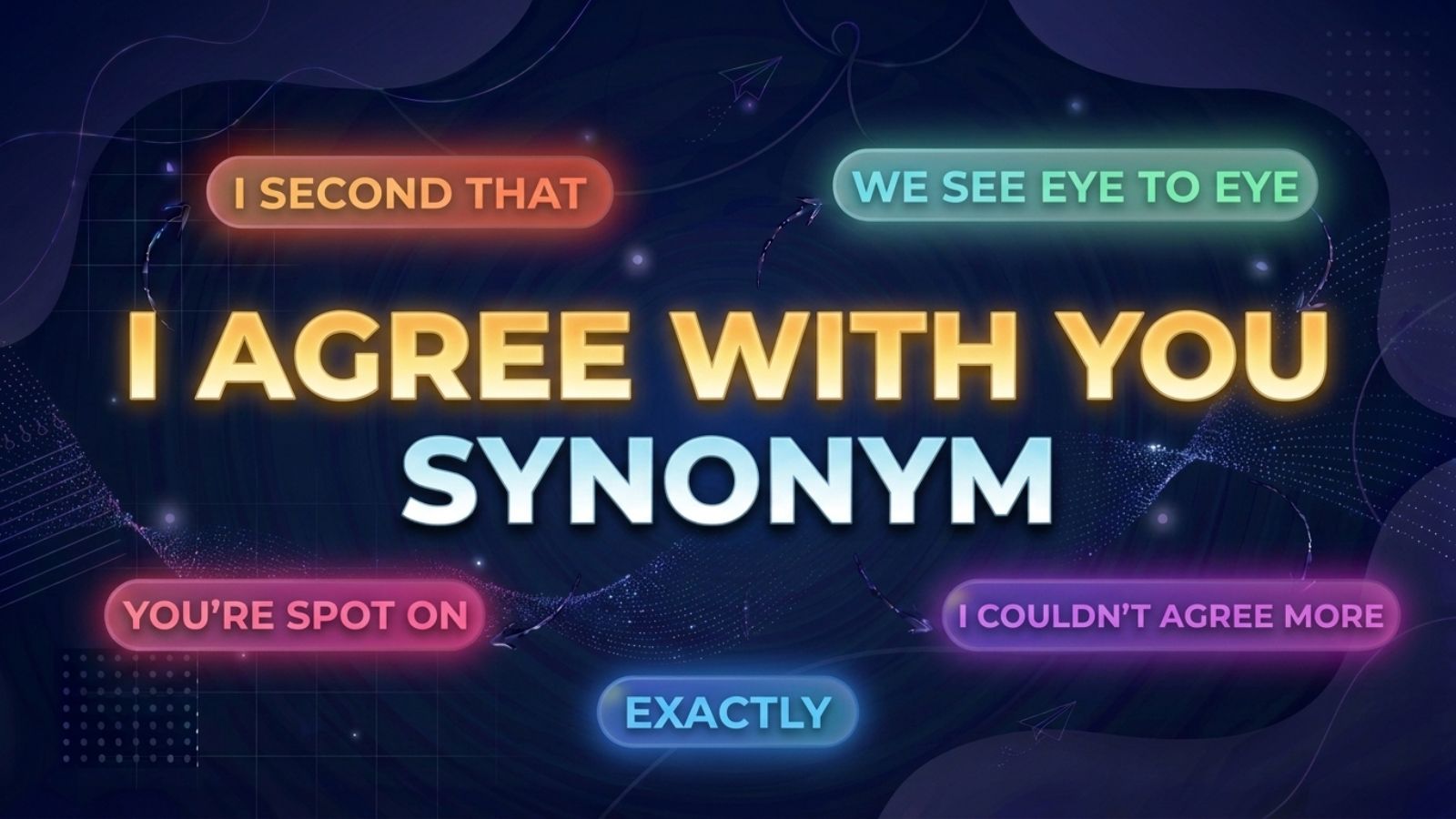
If you are looking for an “I agree with you” synonym, several expressions can help you communicate agreement more naturally, professionally, or confidently. Common alternatives include I completely agree, you’re absolutely right, I feel the same way, I couldn’t agree more, and that’s a good point.
Although these phrases share a similar meaning, they are not interchangeable in every situation. Some work best in professional emails and academic discussions, while others sound more natural in everyday conversations with friends or colleagues. This guide explains the most useful alternatives, their meanings, and example sentences so you can choose the right expression for any situation.
What Does “I Agree With You” Mean?
“I agree with you” is a phrase used to express that you share another person’s opinion, belief, judgment, or conclusion.
It indicates that you think someone is correct or that you support their point of view.
Examples:
- I agree with you about the importance of learning new skills.
- I agree with you that we should finish the project before Friday.
- I agree with you on this matter because the evidence supports your argument.
The phrase is neutral and appropriate in both spoken and written English. However, depending on the situation, you might want a stronger, more polite, more formal, or more conversational alternative.
25 Best Synonyms for “I Agree With You”
Here are 25 useful alternatives, organized by their meanings and contexts.
1. I Completely Agree
Meaning: I share your opinion entirely.
This expression communicates strong agreement without sounding overly formal. It works well in conversations, meetings, and written discussions.
Example: I completely agree that students should have more opportunities to practice speaking English.
2. I Absolutely Agree
Meaning: I strongly agree with what you have said.
Use this phrase when you feel very confident that someone’s opinion is correct.
Example: I absolutely agree that honesty is essential in professional relationships.
3. You’re Absolutely Right
Meaning: Your statement or opinion is correct.
This is a natural expression when someone makes a convincing point or identifies something important.
Example: You’re absolutely right; we should check the figures before submitting the report.
4. I Couldn’t Agree More
Meaning: I agree with you as strongly as possible.
Despite the negative word couldn’t, this expression communicates very strong agreement. It is common in everyday and professional English.
Example: I couldn’t agree more that clear communication makes teamwork easier.
5. That’s Exactly What I Think
Meaning: Your opinion matches my own.
Use this phrase when someone expresses an idea you already believe or have been considering.
Example: That’s exactly what I think about introducing more practical activities into the classroom.
6. I Feel the Same Way
Meaning: I share your feelings or attitude about something.
This expression is particularly useful when discussing personal experiences, emotions, preferences, or concerns.
Example: I feel the same way about spending more time with family.
7. I Share Your View
Meaning: I hold the same opinion or perspective as you.
This alternative is suitable for professional conversations, thoughtful discussions, and formal writing.
Example: I share your view that employee well-being should be a priority.
8. I See It the Same Way
Meaning: I interpret or understand the situation as you do.
This phrase emphasizes a shared perspective rather than simply confirming that someone is correct.
Example: I see it the same way: we need to understand the problem before choosing a solution.
9. That’s a Good Point
Meaning: You have made a reasonable or valuable observation.
This phrase acknowledges the quality of someone’s argument. It often suggests agreement, although it does not necessarily mean you accept everything they have said.
Example: That’s a good point about the additional costs we might face.
10. You Have a Point
Meaning: What you are saying has some merit.
This is useful when someone presents an argument that you recognize as reasonable, even if you do not completely agree with it.
Example: You have a point about the time required to train new employees.
11. I Am of the Same Opinion
Meaning: I hold the same opinion as you.
This expression is more formal than “I agree with you.” It works well in formal discussions, academic contexts, and professional correspondence.
Example: I am of the same opinion regarding the need for clearer guidelines.
12. I Concur
Meaning: I agree with a statement, decision, or conclusion.
Concur is a concise, formal alternative often used in business, academic, and official settings.
Example: I concur with your assessment of the proposed changes.
13. I Endorse That View
Meaning: I support or approve of the opinion being expressed.
Unlike simple agreement, endorse can imply public support or approval. Use it when you want to communicate a stronger commitment to an idea or position.
Example: I endorse the view that education should be accessible to everyone.
14. I Am in Full Agreement
Meaning: I agree completely with the position being discussed.
This formal expression is useful in reports, official correspondence, and structured discussions.
Example: I am in full agreement with the committee’s recommendation.
15. I Support Your Argument
Meaning: I agree with and back up the reasoning you have presented.
This phrase is especially appropriate in debates, presentations, academic discussions, and workplace meetings.
Example: I support your argument that flexible working arrangements can benefit employees.
16. I Am on the Same Page
Meaning: I share your understanding or agree with your approach.
This conversational expression is especially common in teamwork and business discussions. It can refer to having the same understanding, goals, or expectations.
Example: I’m glad we’re on the same page about the project’s priorities.
17. Exactly!
Meaning: I completely agree with the point just made.
This short, enthusiastic response is useful in informal conversations. It works best when the other person’s statement is clear from the context.
Example:
“Everyone should have a chance to share their ideas.”
“Exactly! That’s how a team can make better decisions.”
18. True!
Meaning: What you said is correct or reasonable.
This is a casual way to acknowledge agreement. It is common in everyday speech and informal messages.
Example:
“Getting enough sleep helps you concentrate.”
“True! It makes a difference to my energy, too.”
19. I’m With You on That
Meaning: I agree with your opinion or position.
This friendly, informal expression works well in conversations with friends, classmates, and colleagues.
Example: I’m with you on that; we should focus on quality rather than speed.
20. You’ve Got That Right
Meaning: Your statement is correct.
This phrase is conversational and often emphasizes confident agreement. Depending on the speaker’s tone, it can also sound emphatic or humorous.
Example: You’ve got that right; preparing for an exam takes consistent effort.
21. I Second That
Meaning: I support a suggestion or opinion already expressed by someone else.
The phrase is especially useful in group discussions when another person has proposed an idea you support.
Example: “We should schedule shorter meetings.”
“I second that. It would give everyone more time to work.”
22. I’m in Agreement With You
Meaning: I share your opinion or position.
This is a relatively formal alternative, although it can sound wordier than the simpler “I agree with you.”
Example: I am in agreement with you regarding the proposed timetable.
23. That Makes Sense
Meaning: Your explanation or reasoning seems logical.
This phrase indicates that you understand and accept the reasoning presented. However, understanding someone’s explanation does not always mean agreeing with every conclusion.
Example: That makes sense; reducing unnecessary steps could save us time.
24. I’m Inclined to Agree
Meaning: I tend to agree, although I may not be completely certain.
This measured expression is useful when you find an argument convincing but want to leave room for further discussion.
Example: I’m inclined to agree with your recommendation, provided we can manage the costs.
25. I’m in Total Agreement With You
Meaning: I agree entirely with your position.
This phrase emphasizes complete agreement. It is understandable in professional and everyday English, although “I completely agree” is usually more concise and natural.
Example: I’m in total agreement with you about the importance of protecting personal information.
Best Alternatives to “I Agree With You” by Situation
The best synonym depends on your audience, purpose, and level of formality. Use the following table to find an expression that fits your needs.
| Situation | Best alternative | Tone |
|---|---|---|
| Everyday conversation | I completely agree | Neutral |
| Strong agreement | I couldn’t agree more | Emphatic |
| Professional email | I concur | Formal |
| Academic discussion | I share your view | Formal |
| Friendly conversation | I’m with you on that | Casual |
| Team meeting | I’m on the same page | Conversational |
| Group decision | I second that | Supportive |
| Acknowledging a good argument | That’s a good point | Considerate |
| Partial agreement | I’m inclined to agree | Cautious |
| Emotional discussion | I feel the same way | Empathetic |
Remember that acknowledging an argument is not always the same as agreeing with it. For example, “That’s a good point” recognizes a useful observation, whereas “I completely agree” explicitly expresses agreement.
Formal Synonyms for “I Agree With You”
When writing professional emails, academic assignments, reports, or official messages, you may want an expression that sounds measured and respectful.
Consider these options:
- I concur with your assessment. Suitable for professional evaluations and formal discussions.
- I share your perspective. Useful when you agree with someone’s overall viewpoint.
- I am in full agreement with your proposal. Appropriate when supporting a specific recommendation.
- I support your conclusion. Best when you agree with the outcome of an argument or analysis.
- I agree with your interpretation. Useful when discussing information, evidence, or a text.
- Your assessment aligns with my understanding. Appropriate when confirming that your interpretation matches someone else’s.
- I endorse this recommendation. Suitable when you want to express clear support for a proposed action.
Example in a professional email:
“I concur with your assessment of the current process. I believe the proposed revisions could make our workflow more efficient.”
For most workplace messages, “I agree with your suggestion” is also perfectly professional. You do not need to use complicated vocabulary to sound intelligent or respectful.
Informal Ways to Say “I Agree With You”
In casual conversations, texting, and friendly discussions, shorter expressions often sound more natural.
Here are some popular choices:
- Exactly! — You agree completely.
- Totally! — You strongly agree in a casual way.
- For sure! — You agree confidently.
- Absolutely! — You express enthusiastic agreement.
- So true! — You agree that something is accurate.
- I’m with you. — You support someone’s position.
- You bet! — A friendly, informal expression of affirmation.
- No doubt! — You express strong confidence or agreement.
- Right! — You confirm or agree with a point.
- Couldn’t have said it better myself. — You think someone has expressed your own view particularly well.
Example conversation:
“Working on a difficult task becomes easier when everyone cooperates.”
“Absolutely! Teamwork makes a real difference.”
These alternatives are useful in everyday speech, but some may sound too casual in a formal letter or academic paper.
How to Express Strong Agreement Politely
Sometimes you want to show that you agree without sounding abrupt or overly enthusiastic. This is particularly important in professional conversations, classroom discussions, and situations where respect matters.
Try these expressions:
- I agree with your reasoning. Focuses on the logic behind the argument.
- I think you’ve made an excellent point. Shows appreciation for someone’s contribution.
- I share your concerns. Communicates agreement about a problem or risk.
- I believe you’re right about that. Expresses agreement in a measured way.
- I agree with your recommendation. Clearly supports a suggested action.
- That’s a reasonable conclusion. Acknowledges that the conclusion follows logically from the information available.
For example, instead of saying, “You’re wrong about the schedule,” you could say, “I see your point about the schedule, and I agree that we should review the deadlines.”
Polite agreement does not require excessive praise. Choose words that genuinely reflect what you think.
Examples of “I Agree With You” Synonyms in Sentences
Seeing these expressions in context makes it easier to understand how they work in real communication.
- I completely agree: I completely agree that reading regularly can improve vocabulary.
- You’re absolutely right: You’re absolutely right; we need more information before making a decision.
- I concur: I concur with the findings presented in the report.
- I feel the same way: I feel the same way about spending more time outdoors.
- That’s a good point: That’s a good point about making the instructions easier to follow.
- I’m on the same page: I’m on the same page regarding our plans for next week.
- I second that: I second that suggestion because it would help everyone participate.
- I share your view: I share your view that practical experience is valuable.
- I’m inclined to agree: I’m inclined to agree, although I’d like to review the figures first.
- I couldn’t agree more: I couldn’t agree more that respectful communication matters.
- I support your argument: I support your argument because the examples clearly illustrate the issue.
- Exactly: Exactly! We should solve the underlying problem instead of treating the symptoms.
Notice how each expression fits a slightly different purpose. Some communicate certainty, others acknowledge reasoning, and a few leave room for discussion.
Common Mistakes When Expressing Agreement
English learners sometimes choose an expression that is grammatically correct but unsuitable for the intended meaning.
1. Confusing “I Understand” With “I Agree”
Understanding an opinion does not mean accepting it.
❌ I understand your explanation, so I agree with you.
✅ I understand your explanation, but I haven’t decided whether I agree.
Use understand when you comprehend something and agree when you share the opinion or conclusion.
2. Using “I Concur” in Every Conversation
“I concur” is correct, but it can sound stiff in a relaxed conversation.
Less natural for casual speech: “I concur with your opinion about this movie.”
More natural: “I agree with you about this movie.”
Match the expression to the setting and the people involved.
3. Treating “That’s a Good Point” as Complete Agreement
You can recognize a strong argument without accepting the entire position.
For example, “That’s a good point, but I think we should consider another option” acknowledges someone’s reasoning while expressing a different view.
4. Using “I Second That” Without a Previous Suggestion
“I second that” generally works when someone has already suggested an idea, proposal, or position that you want to support.
Natural: “Let’s arrange an extra revision session.”
“I second that!”
For a general opinion that has not been presented as a suggestion, “I agree” may be more suitable.
Frequently Asked Questions
1. What is the best synonym for “I agree with you”?
“I completely agree” is one of the best general alternatives. It sounds natural in everyday conversations and many professional situations. For stronger agreement, use “I couldn’t agree more.” For formal discussions, “I concur” may be appropriate.
2. How do you say “I agree with you” professionally?
You can say “I concur with your assessment,” “I share your perspective,” or “I agree with your recommendation.” The most appropriate choice depends on the context. In most workplace emails, “I agree with your suggestion” is clear and professional.
3. What is a short way to express agreement?
Common short expressions include “Exactly,” “Absolutely,” “Agreed,” “True,” and “Right.” These are especially useful in conversations and informal messages. In formal writing, a complete sentence may communicate your position more clearly.
4. What is another way to say “I totally agree”?
You can say “I completely agree,” “I absolutely agree,” “I couldn’t agree more,” or “That’s exactly what I think.” All communicate strong agreement, but their tone and suitability vary slightly.
5. Is “I concur” the same as “I agree”?
Yes, both expressions communicate agreement. However, “I concur” is generally more formal and is often used in professional, academic, or official discussions. “I agree” is more versatile and natural in everyday English.
6. How do you express partial agreement?
Use phrases such as “I partly agree,” “I agree with you to some extent,” or “I’m inclined to agree.” You can also say, “I agree with your main point, but I see one issue differently.” These expressions show that you accept part of an argument without endorsing everything.
Conclusion
Learning different ways to say “I agree with you” helps you communicate more naturally and choose the right tone for each situation. Use “I completely agree” for general agreement, “I couldn’t agree more” for strong support, “I concur” in formal discussions, and “I’m with you on that” in casual conversations.
Remember that some expressions communicate complete agreement, while others simply acknowledge a reasonable point or show partial support. Pay attention to the meaning, audience, and context before choosing an alternative. Practicing these phrases in conversations, emails, and writing assignments will help you develop more precise and confident English.