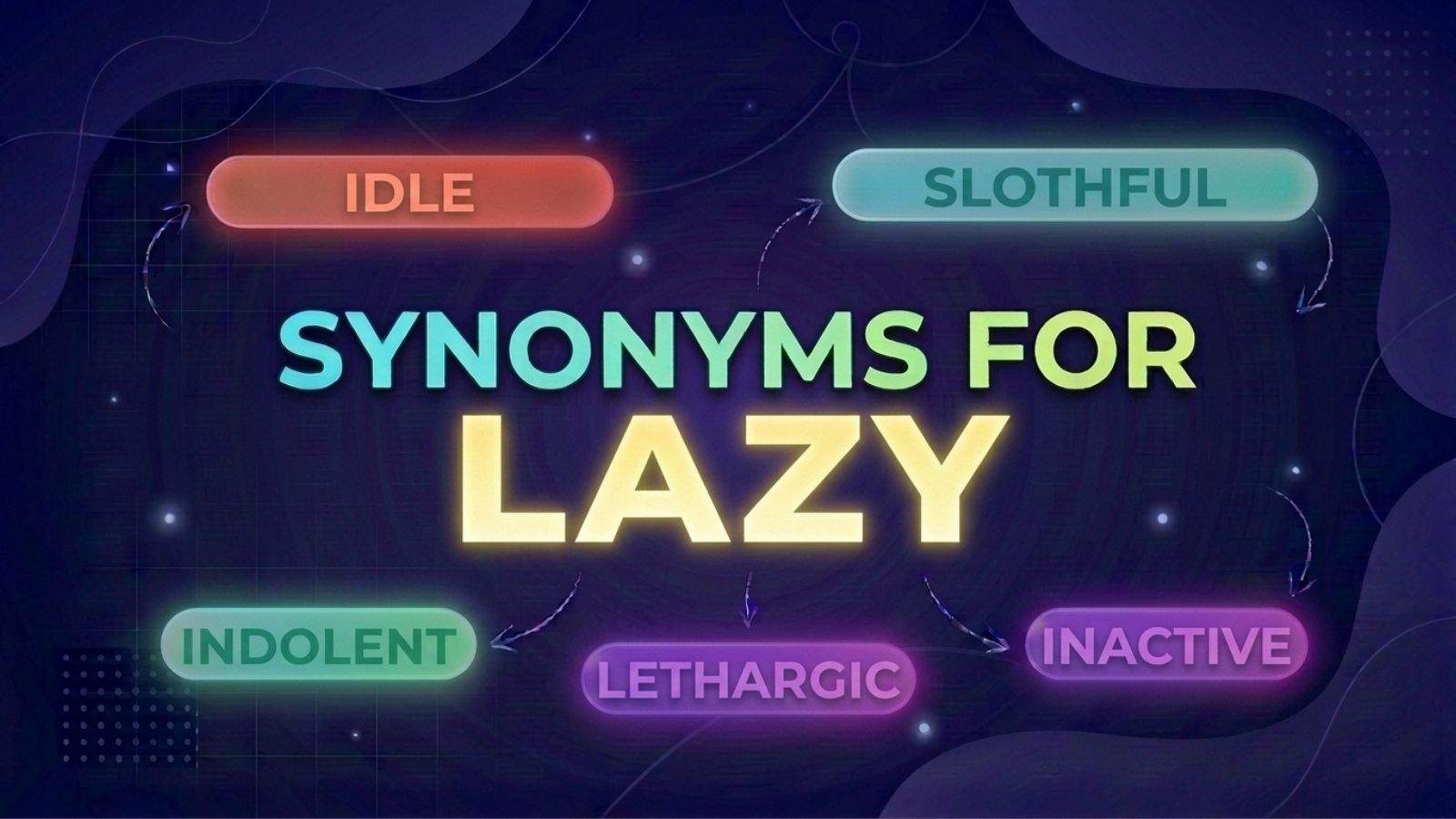
Looking for a lazy synonym that better expresses a person’s behavior, work habits, or lack of motivation? Common alternatives include idle, inactive, unmotivated, indolent, sluggish, and lethargic. However, these words do not all mean exactly the same thing. Some describe a lack of effort, while others refer to low energy, slow movement, or a temporary lack of motivation.
Choosing the right alternative can make your writing more precise, especially in essays, professional communication, creative writing, and everyday conversations. This guide explores more than 30 synonyms for lazy, explains their meanings, provides natural example sentences, and shows which words work best in formal, informal, and context-specific situations.
What Does Lazy Mean?
Lazy is an adjective that describes someone who is unwilling to make the effort needed to do something, or something characterized by little activity or effort.
In everyday English, lazy often describes a person who avoids work, postpones responsibilities, or prefers not to exert themselves. However, it can also describe a relaxed day, slow movement, or an action performed with little effort.
Examples:
- He was too lazy to clean his room.
- I had a lazy Sunday at home.
- She took a lazy walk along the beach.
- The student received criticism for his lazy approach to the assignment.
Notice that lazy can have a negative meaning when describing someone’s responsibilities, but a relaxed or pleasant meaning when describing a day off.
Common Synonyms for Lazy
These alternatives are useful in everyday conversations, school assignments, and general writing. The best choice depends on the behavior you want to describe.
1. Idle
Meaning: Not working, active, or occupied.
Idle focuses on a lack of activity rather than necessarily suggesting unwillingness to work.
Example: The workers remained idle while the machine was being repaired.
2. Inactive
Meaning: Not engaging in activity or not functioning actively.
This word is generally more neutral than lazy.
Example: He had been inactive for several weeks after finishing the project.
3. Unmotivated
Meaning: Lacking the desire or enthusiasm to do something.
Use this word when someone struggles to find a reason or drive to act.
Example: She felt unmotivated to study after receiving disappointing results.
4. Indolent
Meaning: Habitually avoiding effort or work.
Indolent is a formal alternative that often carries a negative judgment.
Example: The manager criticized the employee’s indolent attitude toward important tasks.
5. Sluggish
Meaning: Moving, responding, or operating slowly.
Sluggish emphasizes slowness rather than unwillingness to work.
Example: I felt sluggish after staying up too late.
6. Lethargic
Meaning: Feeling unusually low in energy or lacking alertness.
This word describes a state of low energy, not necessarily a person’s attitude toward work.
Example: The hot weather left everyone feeling lethargic.
7. Unproductive
Meaning: Not producing useful results or making effective progress.
Example: I had an unproductive afternoon because I kept getting distracted.
8. Apathetic
Meaning: Showing little interest, concern, or enthusiasm.
Example: The audience seemed apathetic during the presentation.
9. Listless
Meaning: Lacking energy, enthusiasm, or interest.
Example: He felt listless after a long and demanding week.
10. Lackadaisical
Meaning: Showing little enthusiasm, energy, or care in doing something.
Example: Her lackadaisical preparation affected the quality of her presentation.
11. Negligent
Meaning: Failing to take proper care or fulfill a responsibility.
Negligent is stronger and more specific than lazy because it suggests a failure to meet a duty.
Example: The supervisor was negligent in checking the safety procedures.
12. Careless
Meaning: Not giving enough attention or thought to avoid mistakes.
Example: His careless work contained several avoidable errors.
13. Slothful
Meaning: Habitually unwilling to work or make an effort.
Example: The story portrays a slothful character who avoids every responsibility.
14. Halfhearted
Meaning: Done without much enthusiasm, commitment, or effort.
Example: He made a halfhearted attempt to organize his desk.
15. Laid-back
Meaning: Relaxed and not easily worried or stressed.
Unlike lazy, laid-back often has a positive or neutral tone.
Example: Her laid-back personality helps everyone feel comfortable.
Formal Synonyms for Lazy
When writing academic essays, reports, or professional documents, it is useful to select words that describe specific behavior instead of simply labeling someone lazy.
| Synonym | Meaning | Example |
|---|---|---|
| Indolent | Habitually avoiding effort | His indolent approach delayed the project. |
| Inactive | Not participating in activity | The account remained inactive for months. |
| Unmotivated | Lacking the desire to act | The team appeared unmotivated after the setback. |
| Lackadaisical | Showing little care or enthusiasm | The report reflected a lackadaisical approach. |
| Negligent | Failing to fulfill a duty properly | The inspection was negligent. |
| Unproductive | Failing to produce useful results | The meeting was unproductive. |
| Remiss | Careless or failing to do what is expected | I would be remiss if I ignored this issue. |
| Inefficient | Wasting time, effort, or resources | The inefficient process slowed the team. |
Important distinction: Remiss and negligent refer to failing in a responsibility, while inefficient means achieving results with unnecessary waste. Neither word automatically means a person is lazy.
For professional writing, describe the specific problem whenever possible. For example, “The employee repeatedly missed deadlines” is often more informative than “The employee was lazy.”
Informal and Casual Words for Lazy
In everyday conversation, these words can sound more natural than formal alternatives.
1. Slacker
A person who avoids work or fails to contribute a fair share.
Example: Nobody wanted to be the slacker who left all the cleaning to everyone else.
2. Couch potato
An informal expression for someone who spends a lot of time sitting or relaxing, especially while watching television.
Example: I turned into a couch potato during the rainy weekend.
3. Unambitious
Lacking a strong desire to achieve advancement or particular goals.
Example: He was comfortable with his current position and did not consider himself ambitious.
This word does not necessarily mean someone avoids everyday responsibilities.
4. Work-shy
Unwilling to work or inclined to avoid work. This expression is more common in British English.
Example: The character is portrayed as work-shy and reluctant to accept new duties.
5. Shiftless
An informal or literary term for someone who lacks initiative or responsibility.
Example: The novel describes a shiftless young man who struggles to organize his life.
6. Leisurely
Done in a relaxed manner without rushing.
Example: We enjoyed a leisurely breakfast on Sunday.
Leisurely is not a direct synonym for lazy. It describes a relaxed pace and does not imply that someone is avoiding responsibilities.
Synonyms for Lazy Based on Behavior
Sometimes, the most accurate alternative depends on why someone appears lazy.
When Someone Avoids Work
Consider:
- Idle: Not currently working.
- Indolent: Habitually unwilling to exert effort.
- Slothful: Avoiding work or effort.
- Work-shy: Reluctant to work.
- Shiftless: Lacking initiative or a sense of responsibility.
Example: Rather than describing the employee as lazy, you could say, “He repeatedly avoided tasks assigned to him.”
This wording identifies the behavior more clearly.
When Someone Lacks Motivation
Consider:
- Unmotivated: Lacking the desire to act.
- Apathetic: Showing little interest or concern.
- Listless: Lacking energy or enthusiasm.
- Halfhearted: Showing limited commitment.
- Disengaged: Not actively involved or interested.
Example: The students seemed disengaged during the lecture, so the teacher introduced a group activity.
These words are useful because a lack of motivation is not necessarily the same as unwillingness to work.
When Someone Moves Slowly
Consider:
- Sluggish: Moving or responding slowly.
- Lethargic: Having low energy or alertness.
- Languid: Moving slowly in a relaxed or unhurried manner.
- Inactive: Not physically active.
Example: The computer became sluggish when too many applications were running.
Here, sluggish describes performance rather than laziness. Similarly, a person who feels tired or unwell should not automatically be described as lazy.
When Someone Does Not Pay Enough Attention
Consider:
- Careless: Not paying sufficient attention.
- Negligent: Failing to exercise the required care.
- Remiss: Failing to do something expected.
- Halfhearted: Making an effort without real commitment.
Example: The careless student submitted an assignment without checking the spelling.
These words focus on the quality of someone’s work rather than the amount of energy they have.
Positive Alternatives to Lazy
Not every situation described as lazy is negative. Sometimes, people simply want to express that they are relaxing or avoiding unnecessary effort.
Here are several alternatives with more positive or neutral meanings.
| Word or phrase | Meaning | Example |
|---|---|---|
| Relaxed | Free from tension or pressure | I felt relaxed during the holiday. |
| Laid-back | Calm and easygoing | He has a laid-back approach to life. |
| Leisurely | Unhurried and comfortable | We took a leisurely stroll. |
| Easygoing | Relaxed and not easily upset | My easygoing friend rarely worries about small problems. |
| Unhurried | Taking time without rushing | She enjoyed an unhurried morning. |
| Restful | Helping someone relax or recover energy | It was a restful afternoon at home. |
| Low-key | Calm, simple, and not elaborate | We planned a low-key weekend. |
For example, “I had a lazy afternoon” may sound perfectly natural when you mean you relaxed without doing much. In that situation, restful, relaxed, or unhurried may communicate the same idea without suggesting a negative attitude.
Lazy Synonyms for Essays and Professional Writing
If you are writing an essay, report, or résumé, avoid repeating lazy when a more precise word is available.
Consider these examples.
Original: The student was lazy about completing assignments.
Alternative: The student consistently procrastinated on assignments.
Procrastinated means delayed tasks unnecessarily. It describes a particular behavior rather than making a general judgment about the student.
Original: The team was lazy during the project.
Alternative: The team showed limited initiative during the project.
This alternative identifies a lack of independent action.
Original: The process was lazy and ineffective.
Alternative: The process was poorly designed and inefficient.
This revision describes the actual problem with the process.
Original: He gave a lazy answer.
Alternative: He gave a superficial answer.
Superficial suggests that the answer lacked depth or careful consideration.
For academic writing, alternatives such as unmotivated, inefficient, careless, disengaged, and lacking initiative are useful when they accurately describe the situation. Avoid using complicated vocabulary simply to make your writing sound formal.
Lazy Synonyms: Quick Comparison
Use this guide to select the word that best fits your sentence.
| If you mean… | Use… |
|---|---|
| Avoiding work habitually | Indolent |
| Not currently doing anything | Idle |
| Lacking motivation | Unmotivated |
| Showing little interest | Apathetic |
| Having low energy | Lethargic |
| Moving or responding slowly | Sluggish |
| Producing few useful results | Unproductive |
| Failing to meet a responsibility | Negligent |
| Not paying enough attention | Careless |
| Making little effort | Halfhearted |
| Avoiding work informally | Slacker |
| Relaxing without rushing | Leisurely |
| Calm and easygoing | Laid-back |
| Delaying tasks | Procrastinating |
| Lacking independent initiative | Passive |
Remember that passive means not taking action or not actively participating. It can describe behavior that resembles laziness in some contexts, but it does not necessarily mean someone is unwilling to work.
What Is the Opposite of Lazy?
The opposite of lazy depends on the quality you want to emphasize. Useful antonyms include:
- Hardworking: Putting consistent effort into tasks.
- Diligent: Working carefully and persistently.
- Industrious: Regularly working hard and productively.
- Energetic: Showing a high level of energy.
- Motivated: Having a reason or desire to act.
- Productive: Producing useful results.
- Conscientious: Taking responsibilities seriously and making an effort to do things properly.
- Proactive: Taking action before being prompted or before problems develop.
Examples:
- The diligent student reviewed every chapter before the examination.
- Our hardworking team completed the project ahead of schedule.
- She took a proactive approach to solving the problem.
- He remained productive throughout the afternoon.
These words are not identical. Someone can be energetic without being productive, and someone can be hardworking without always being efficient.
Frequently Asked Questions
1. What is the best synonym for lazy?
Idle, unmotivated, and indolent are useful synonyms, depending on context. Idle means inactive, unmotivated means lacking the desire to act, and indolent describes someone who habitually avoids effort.
2. What is a more professional word for lazy?
Consider unmotivated, disengaged, inefficient, or lacking initiative. The most appropriate choice depends on the behavior you are describing. For professional communication, specific observations are usually more constructive than personal labels.
3. What is a polite way to say someone is lazy?
You could say that someone is “not taking initiative,” “struggling to stay engaged,” or “not consistently meeting expectations.” These expressions focus on observable behavior and avoid unnecessarily insulting the person.
4. What is a strong word for lazy?
Indolent and slothful are strong words for someone who habitually avoids effort. Shiftless can also suggest a lack of initiative or responsibility. All three can sound judgmental.
5. What is the opposite of lazy?
Common antonyms include hardworking, diligent, industrious, motivated, and productive. Choose diligent when you mean careful, persistent effort and productive when you mean producing useful results.
6. Is sluggish the same as lazy?
No. Sluggish describes slow movement, responses, or performance, while lazy often suggests an unwillingness to make an effort. A tired person or slow computer can be sluggish without being lazy.
Conclusion
The best lazy synonym depends on what you want to describe. Use idle for inactivity, unmotivated for a lack of drive, indolent for habitual avoidance of effort, and sluggish for slow movement or responses. In professional writing, words such as disengaged, inefficient, and lacking initiative can communicate specific concerns more clearly. If you are describing relaxation rather than avoiding responsibilities, laid-back, leisurely, or restful may be more suitable. Choosing precise vocabulary helps you express your meaning accurately without making unnecessary judgments about others.