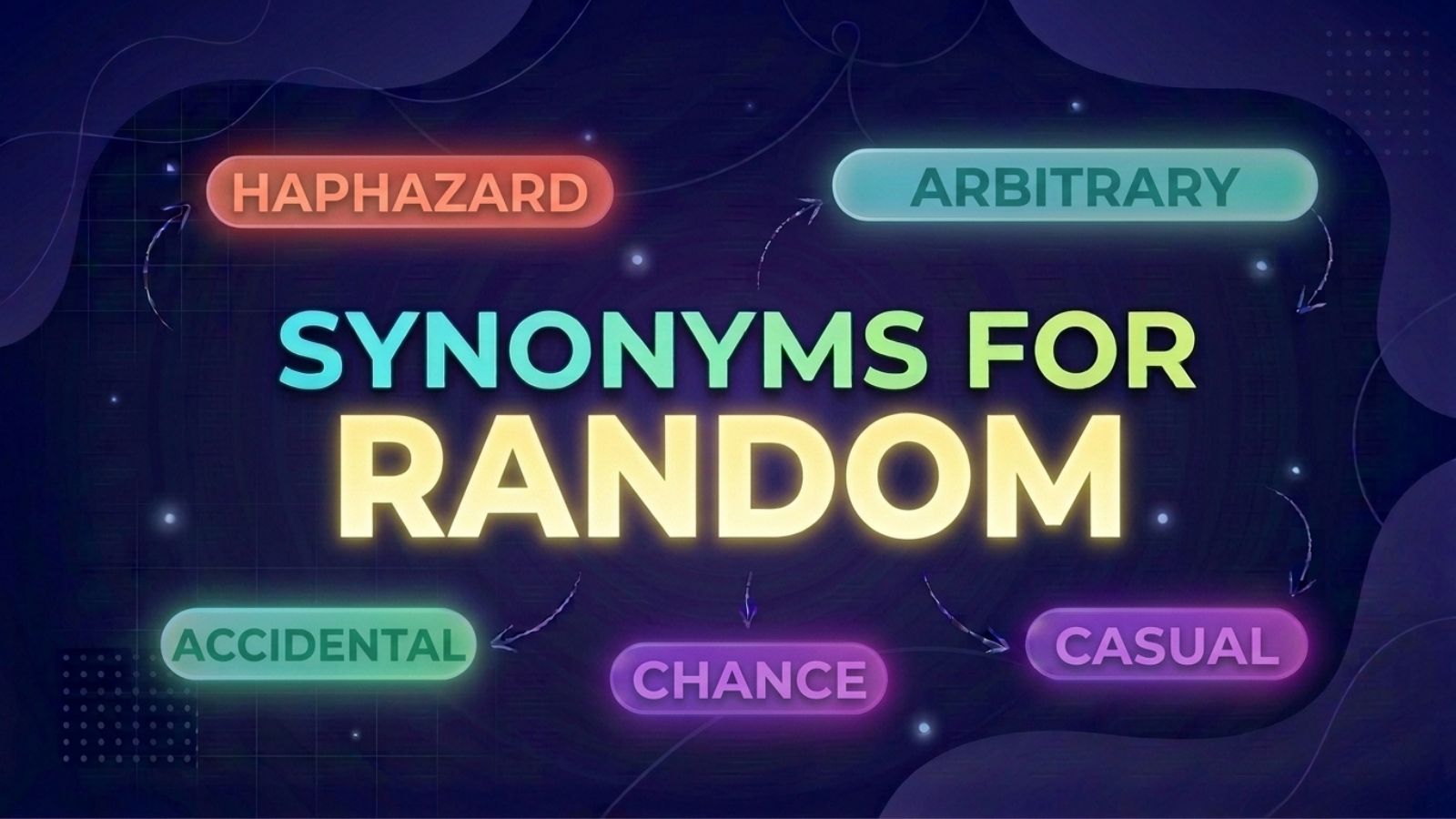
Looking for random synonyms to make your writing more varied, your vocabulary stronger, or your conversations more natural? The word random has several alternatives, including arbitrary, haphazard, unplanned, unexpected, spontaneous, and unpredictable. However, these words do not all mean exactly the same thing. Some describe a choice made without a specific pattern, while others refer to something that happens suddenly or without preparation.
Whether you are writing an essay, creating a social media caption, improving your English, or searching for a more precise word, choosing the right synonym matters. This guide explores more than 30 alternatives to random, explains their meanings, and provides practical examples to help you use them correctly.
What Does Random Mean?
Random is an adjective that describes something selected, occurring, or arranged without following a particular pattern, predictable order, or deliberate selection criterion. In some contexts, it can also be used as a noun, particularly in informal speech.
For example:
- The computer generated a random number.
- We met a random person at the event.
- She shared a random thought during lunch.
- The questions appeared in random order.
In everyday conversation, random can also describe something unexpected, unusual, or unrelated to the current topic.
The best synonym depends on which meaning you want to communicate. For example, arbitrary may describe a decision made without a clear reason, while spontaneous describes an action performed without prior planning.
30+ Best Random Synonyms With Meanings
Here are useful alternatives to random, organized by their meanings and common applications.
1. Common Synonyms for Random
These words are useful in everyday English, although they differ slightly in meaning.
1. Arbitrary
Meaning: Based on personal choice or authority rather than a clear rule, reason, or consistent principle.
Example: The manager made an arbitrary decision about the schedule.
2. Unplanned
Meaning: Not arranged or prepared in advance.
Example: Our unplanned visit turned into a wonderful afternoon.
3. Unexpected
Meaning: Not anticipated or predicted.
Example: An unexpected message changed her plans.
4. Unpredictable
Meaning: Difficult to anticipate because the outcome or behavior cannot be reliably forecast.
Example: The weather in the mountains is unpredictable.
5. Spontaneous
Meaning: Happening naturally or without prior planning.
Example: We took a spontaneous trip to the countryside.
6. Accidental
Meaning: Happening unintentionally rather than by design.
Example: The accidental discovery led to an interesting conversation.
7. Irregular
Meaning: Not following a consistent pattern, schedule, or arrangement.
Example: The machine produced irregular patterns.
8. Haphazard
Meaning: Done without a clear plan, method, or organized approach.
Example: The documents were stored in a haphazard manner.
9. Unsystematic
Meaning: Lacking a consistent or organized method.
Example: Their unsystematic approach made the results difficult to compare.
10. Chance
Meaning: Related to possibility or events occurring without deliberate planning; it often appears in phrases such as by chance.
Example: We met by chance at a bookstore.
2. Synonyms for Random in Formal Writing
When writing essays, reports, research papers, or professional documents, precision is more important than simply finding a similar word.
11. Indiscriminate
Meaning: Done without careful selection or consideration of relevant differences.
Example: Indiscriminate use of resources can create unnecessary waste.
12. Unsystematic
Meaning: Not organized according to a consistent method.
Example: The report criticized the unsystematic collection of information.
13. Haphazard
Meaning: Lacking order or careful planning.
Example: A haphazard research process may produce unreliable conclusions.
14. Arbitrary
Meaning: Determined without a consistent or clearly justified principle.
Example: The researchers rejected the arbitrary classification of participants.
15. Nonselective
Meaning: Not involving careful selection or discrimination among available options.
Example: The nonselective approach included every eligible record.
16. Unstructured
Meaning: Not organized according to a fixed or clearly defined structure.
Example: The interview began with an unstructured discussion.
17. Unsystematized
Meaning: Not arranged or developed into a coherent system.
Example: The information remained unsystematized and difficult to analyze.
These words are not interchangeable in every academic context. For example, indiscriminate can suggest careless selection, while unstructured simply indicates the absence of a fixed structure.
3. Synonyms for Random Meaning Strange or Unusual
In casual English, random sometimes describes something odd, funny, surprising, or unrelated to the situation.
18. Odd
Meaning: Unusual or different from what is expected.
Example: He asked an odd question during the meeting.
19. Unusual
Meaning: Not commonly seen or experienced.
Example: She had an unusual idea for the school project.
20. Bizarre
Meaning: Extremely strange or unexpected.
Example: The movie featured a bizarre sequence of events.
21. Eccentric
Meaning: Unconventional or noticeably different from common behavior or styles.
Example: The artist was known for his eccentric designs.
22. Absurd
Meaning: Illogical, unreasonable, or difficult to take seriously.
Example: Their discussion turned into an absurd argument about imaginary problems.
23. Quirky
Meaning: Unusual in an interesting, playful, or appealing way.
Example: The café is famous for its quirky decorations.
24. Unconventional
Meaning: Different from traditional or commonly accepted methods.
Example: The team tried an unconventional solution to the problem.
25. Outlandish
Meaning: Extremely unusual, exaggerated, or difficult to believe.
Example: He suggested an outlandish explanation for the mysterious noise.
These words are especially useful when random refers to an unusual idea or unexpected behavior rather than a genuinely random selection.
Random Synonyms by Context
The most effective synonym is the one that matches the situation. Use the following categories to choose an appropriate alternative.
1. Random Choices and Selections
When something is chosen without a predetermined preference or through a chance-based process, consider:
- Random: Selected without a specific predictable pattern.
- Arbitrary: Chosen without a clear or consistent justification.
- Chance-based: Determined through chance.
- Nonselective: Not based on careful distinctions between options.
- Unplanned: Not arranged beforehand.
Example: The application selects a random winner from the entries.
If the selection is genuinely random, random or chance-based is often more accurate than arbitrary. An arbitrary choice may be made by a person without a clear reason, whereas a random selection can follow a defined procedure.
2. Random Events and Situations
When discussing something that happens without preparation or expectation, use:
- Unexpected: Not anticipated.
- Unplanned: Not prepared in advance.
- Spontaneous: Arising naturally without prior planning.
- Accidental: Happening unintentionally.
- Unforeseen: Not predicted or anticipated.
- Sudden: Happening quickly or with little warning.
Examples:
- We had an unexpected visitor.
- Their spontaneous decision made the evening memorable.
- An accidental meeting brought old friends together.
- The project faced unforeseen difficulties.
Although these words overlap, sudden emphasizes timing, while accidental emphasizes the absence of intention.
3. Random Patterns and Arrangements
When something lacks a consistent order, consider:
- Irregular: Not following a consistent pattern.
- Haphazard: Arranged or done without a clear plan.
- Disordered: Lacking proper order.
- Unstructured: Not organized according to a fixed structure.
- Chaotic: Characterized by confusion or disorder.
Example: The papers were arranged haphazardly across the desk.
Chaotic is stronger than random because it suggests disorder or confusion. A random arrangement can still be orderly in its own way, depending on the context.
4. Random Thoughts and Conversations
For informal speech, creative writing, and social media, these expressions may fit:
- Offbeat: Unusual or unconventional.
- Quirky: Peculiar in an interesting or amusing way.
- Spontaneous: Arising naturally.
- Unexpected: Surprising or unanticipated.
- Unrelated: Not connected to the subject being discussed.
- Out of the blue: Happening or appearing unexpectedly.
Example: Out of the blue, she asked whether penguins could recognize individual people.
For this kind of sentence, out of the blue sounds natural because the focus is on the surprising timing of the question.
Random Synonyms: Quick Comparison Table
Use this table to find a suitable alternative at a glance.
| Synonym | Main meaning | Best context |
|---|---|---|
| Arbitrary | Chosen without a clear principle | Decisions and rules |
| Spontaneous | Occurring without prior planning | Actions and activities |
| Unexpected | Not anticipated | Events and surprises |
| Unpredictable | Difficult to forecast | Behavior and outcomes |
| Haphazard | Lacking a clear method | Arrangements and processes |
| Irregular | Not following a consistent pattern | Schedules and shapes |
| Accidental | Happening unintentionally | Mistakes and discoveries |
| Indiscriminate | Without careful selection | Actions and decisions |
| Unstructured | Without a fixed organization | Interviews and discussions |
| Quirky | Unusual in an interesting way | Personality and style |
| Absurd | Illogical or unreasonable | Ideas and situations |
| Chaotic | Confused or disordered | Environments and events |
What Is the Difference Between Random, Arbitrary, and Spontaneous?
These three words are sometimes confused because they can all describe situations that are not carefully planned. However, each emphasizes something different.
Random focuses on the absence of a predictable selection pattern.
Example: The computer generated a random number.
Arbitrary focuses on a decision made without a clear, consistent, or sufficiently justified principle.
Example: The judge rejected the arbitrary restriction.
Spontaneous focuses on an action that happens naturally without being planned beforehand.
Example: We made a spontaneous decision to watch a movie.
A random number can be generated through a defined process. An arbitrary decision may reflect someone’s choice, while a spontaneous action may come from an immediate feeling or opportunity.
Choosing the correct term makes writing more precise, especially in academic and professional contexts.
How to Use Random Synonyms in Sentences
Here are practical examples showing how to replace random without changing the intended meaning unnecessarily.
Example 1: Everyday Conversation
Original: He started talking about random things.
Alternative: He started talking about unrelated things.
Why it works: Unrelated emphasizes that the topics had no clear connection to the previous conversation.
Example 2: Professional Writing
Original: The team used a random method to organize the files.
Alternative: The team used a haphazard method to organize the files.
Why it works: Haphazard suggests the method lacked organization. Use it only if that is what you mean.
Example 3: Creative Writing
Original: We went on a random trip.
Alternative: We went on an unplanned trip.
Why it works: Unplanned clearly communicates that the trip had not been arranged beforehand.
Example 4: Research and Statistics
Original: The participants were selected randomly.
Alternative: The participants were selected through a chance-based procedure.
Why it works: The alternative emphasizes the role of chance in the selection process. In technical writing, retain established statistical terminology when appropriate.
Example 5: Social Media
Original: Here are some random pictures from my weekend.
Alternative: Here are some miscellaneous pictures from my weekend.
Why it works: Miscellaneous suggests a collection of different items rather than a single themed group.
Common Mistakes When Choosing Random Synonyms
1. Treating all synonyms as identical
Random, unexpected, and spontaneous have overlapping meanings, but they express different ideas. Check what the sentence emphasizes before replacing one with another.
2. Using arbitrary when you mean accidental
An arbitrary decision involves a choice without a clear or consistent basis. An accidental event happens unintentionally.
Incorrect: I made an arbitrary mistake when I dropped the glass.
Better: I accidentally dropped the glass.
3. Using haphazard to describe every random selection
Haphazard often suggests poor organization or careless methods. A carefully conducted random selection does not necessarily involve any carelessness.
4. Using informal words in formal writing
Words such as quirky and out of the blue can work well in conversational writing, but they may not suit every research paper or formal report.
5. Assuming random always means strange
In statistical and technical contexts, random has a specific meaning related to chance or probability. A random sample is not necessarily strange, unusual, or poorly organized.
Frequently Asked Questions
1. What are the best synonyms for random?
Some useful synonyms are arbitrary, spontaneous, unexpected, unpredictable, haphazard, irregular, accidental, and unplanned. The best choice depends on whether you mean a chance-based selection, an unplanned action, or an unusual event.
2. What is a formal word for random?
Arbitrary, indiscriminate, haphazard, and unsystematic can serve as formal alternatives in suitable contexts. For technical writing about chance-based selection, however, random may be the most precise word.
3. What is another word for random in a sentence?
Depending on the sentence, you might use unplanned, unexpected, spontaneous, or unrelated. For example, “We had an unplanned meeting” emphasizes that the meeting was not arranged in advance.
4. Is arbitrary the same as random?
No. Random generally concerns chance or the absence of a predictable selection pattern. Arbitrary describes a choice made without a clear or consistent reason or principle. The words sometimes overlap but are not interchangeable in every context.
5. What is the opposite of random?
Possible opposites include systematic, planned, ordered, predictable, and deliberate. The correct opposite depends on the intended meaning. For example, systematic contrasts with unsystematic, while planned contrasts with unplanned.
6. What is a casual synonym for random?
In casual conversation, alternatives such as unexpected, spontaneous, quirky, and out of the blue may work. If you mean something strange or funny, quirky or absurd may be suitable, depending on the tone.
Conclusion
The best random synonyms depend on the message you want to communicate. Use arbitrary for choices without a clear principle, spontaneous for unplanned actions, unexpected for surprising events, and haphazard for methods that lack organization. Words such as quirky, absurd, and unconventional are better suited to unusual ideas or behavior.
Rather than replacing random with the first similar word you find, consider the context, tone, and intended meaning. This simple habit can make your English vocabulary more accurate and your writing more natural.