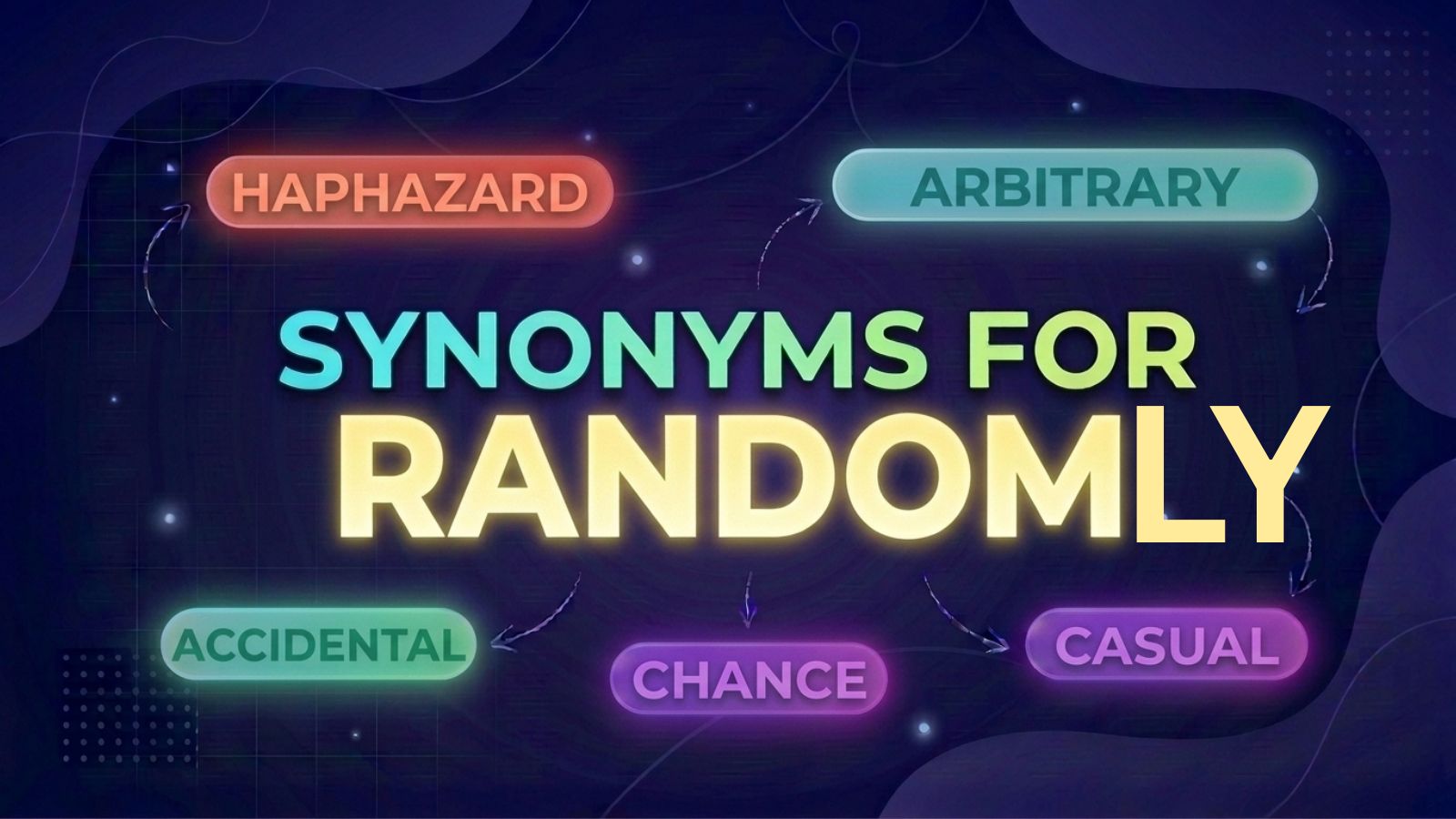
Finding the right randomly synonym depends on what you want to express. The word randomly can describe something that happens by chance, without a plan, without a particular order, or in an unpredictable way. However, these meanings are not always interchangeable. For example, unexpectedly describes something surprising, while haphazardly suggests a lack of organization.
Whether you are writing an academic assignment, improving your vocabulary, or making everyday sentences more varied, choosing the right alternative can make your writing clearer. This guide explores common synonyms for randomly, explains their meanings, provides practical examples, and shows you which alternatives work best in formal, informal, and context-specific situations.
What Does Randomly Mean?
Randomly is an adverb that means happening, being selected, or being done by chance rather than according to a deliberate plan, fixed order, or predictable pattern.
In simple English, randomly means by chance or without a specific pattern.
The word is commonly used when describing how someone selects an item, how events occur, or how something is distributed.
Examples:
- The teacher randomly selected three students to answer the questions.
- The numbers were generated randomly by the computer.
- We randomly met an old friend while walking through the city.
In the first sentence, the teacher did not choose students according to a stated order. In the second, the numbers were generated through a random process. In the third, the meeting happened by chance.
The precise meaning depends on the situation, so the best synonym should preserve the intended meaning.
Best Synonyms for Randomly
Here are some of the most useful alternatives to randomly, with explanations and example sentences.
1. By Chance
Meaning: Happening without being planned or deliberately arranged.
Example: We discovered the little bookstore by chance while exploring the town.
Best for: Everyday conversations and general writing.
2. Haphazardly
Meaning: In a disorganized, careless, or unplanned manner.
Example: The documents were haphazardly scattered across the desk.
Best for: Describing actions that lack order or organization.
Unlike randomly, this word often carries a negative connotation.
3. Arbitrarily
Meaning: Based on personal choice or an unrestricted decision rather than a consistent rule or clear reason.
Example: The committee arbitrarily changed the deadline without consulting the participants.
Best for: Academic, legal, and professional writing.
Arbitrarily does not always mean the same thing as randomly. It can suggest that a decision was made without sufficient justification.
4. Unpredictably
Meaning: In a way that cannot easily be anticipated.
Example: The weather changed unpredictably throughout the afternoon.
Best for: Describing changing conditions, behavior, or events.
5. Accidentally
Meaning: Unintentionally or without meaning to do something.
Example: I accidentally opened the wrong file.
Best for: Situations involving unintended actions.
This is not an exact synonym because an accidental event may result from a mistake rather than chance.
6. Spontaneously
Meaning: Happening naturally, without advance planning or external prompting.
Example: The audience spontaneously began applauding.
Best for: Natural reactions, conversations, and unplanned activities.
7. Irregularly
Meaning: Without a consistent pattern, schedule, or interval.
Example: The machine operated irregularly throughout the test.
Best for: Patterns, schedules, and repeated events.
8. Unsystematically
Meaning: Without following an organized method or structured procedure.
Example: The researcher initially collected the information unsystematically.
Best for: Research, analysis, and technical writing.
9. haphazardly
Meaning: In a disordered way, without careful planning.
Example: The books were haphazardly arranged on the shelves.
Best for: Describing poor organization.
This word overlaps with an earlier entry, but it is worth remembering that it generally implies disorder rather than neutral chance.
10. Unexpectedly
Meaning: In a way that was not anticipated.
Example: The meeting unexpectedly ended earlier than scheduled.
Best for: Surprising events and outcomes.
An event can be unexpected without being random, so use this alternative when surprise is the main idea.
11. Without a Pattern
Meaning: In a way that does not follow a recognizable arrangement or sequence.
Example: The colored dots appeared without a pattern on the screen.
Best for: Explaining visual arrangements, data, and repeated events.
12. At Random
Meaning: By chance, without following a predetermined selection order.
Example: Participants were assigned to groups at random.
Best for: Research, games, experiments, and everyday selection.
This is one of the closest alternatives to randomly in many contexts.
Randomly Synonyms by Context
Not every synonym works equally well in every sentence. Use the following categories to select an alternative that matches your intended meaning.
Common and Everyday Synonyms
These alternatives are useful in conversations, informal writing, and general descriptions.
| Synonym or phrase | Meaning | Example |
|---|---|---|
| By chance | Without planning | We met by chance. |
| At random | Without a predetermined order | Choose a card at random. |
| Unexpectedly | In a surprising way | She arrived unexpectedly. |
| Spontaneously | Without advance planning | They spontaneously started dancing. |
| Accidentally | Without intending to | He accidentally deleted the file. |
Tip: Use by chance when something happens coincidentally, at random when something is selected, and accidentally when an action is unintended.
Formal Synonyms for Randomly
Formal alternatives are particularly helpful in academic essays, reports, research papers, and professional documents.
| Synonym | Meaning or context | Example |
|---|---|---|
| Arbitrarily | Without a consistent or justified basis | The values were assigned arbitrarily. |
| Unsystematically | Without a structured method | The information was collected unsystematically. |
| Stochastically | According to a probabilistic process | The model represents the system stochastically. |
| Indiscriminately | Without making careful distinctions | The policy was applied indiscriminately. |
| Haphazardly | In a disorganized manner | The samples were stored haphazardly. |
These words have different meanings and should not be substituted mechanically.
For example, stochastically is a technical term associated with probability and random processes. It is appropriate in mathematical or scientific contexts but may sound unnecessarily complicated in everyday writing.
Similarly, indiscriminately often means without making appropriate distinctions. It can imply careless or excessive action rather than genuine randomness.
Synonyms for Randomly Selecting Something
When someone chooses a person, number, item, or option without following a predetermined order, these expressions may be suitable:
- At random: The computer selected a number at random.
- By chance: I came across the article by chance.
- Randomly chosen: The randomly chosen participant received a questionnaire.
- Without a predetermined order: The questions were presented without a predetermined order.
- Using random selection: The participants were chosen using random selection.
In research, randomly selected is often preferable when a selection process genuinely uses chance. However, choosing something without a plan does not automatically make the process statistically random.
Synonyms for Acting Randomly
When describing someone’s behavior or the way an action is performed, consider these alternatives:
- Spontaneously: She spontaneously suggested a weekend trip.
- Haphazardly: He haphazardly arranged the equipment.
- Erratically: The vehicle moved erratically along the road.
- Impulsively: He impulsively purchased the expensive jacket.
- Without a clear plan: They worked without a clear plan.
Each expression highlights a different feature.
Erratically emphasizes inconsistent or irregular behavior. Impulsively suggests acting without sufficient thought. Spontaneously often sounds positive or neutral, while haphazardly usually suggests poor organization.
More Words Related to Randomly
The following alternatives can be useful in particular contexts, but their meanings are not identical to randomly.
| Word | Meaning | When to use it |
|---|---|---|
| Casually | Without formality or special effort | Informal actions or remarks |
| Fortuitously | Happening by fortunate chance | Lucky discoveries or outcomes |
| Coincidentally | Happening at the same time or in a related way by chance | Coincidences |
| Aimlessly | Without a clear purpose or direction | Wandering or unproductive activity |
| Disjointedly | In a disconnected or poorly coordinated way | Speech, writing, or sequences |
| Sporadically | Occurring occasionally and irregularly | Infrequent events |
| Haphazardly | Without order or careful planning | Disorganized actions |
| Unintentionally | Without meaning to do something | Accidental actions |
| Impromptu | Without preparation or advance planning | Speeches, meetings, or performances |
| Fortuitously | Through favorable chance | Unexpectedly fortunate events |
Notice that some entries are more suitable for describing events, while others describe how a person acts. Choosing a synonym that matches the sentence is more important than selecting an impressive-sounding word.
Randomly vs. Similar Words: What Is the Difference?
Several English words are frequently confused with randomly. Understanding their differences helps prevent awkward or inaccurate sentences.
Randomly vs. Arbitrarily
Randomly generally refers to chance or a random process. Arbitrarily often refers to a choice made without a consistent rule or sufficient reason.
- Randomly: The software randomly generated the test numbers.
- Arbitrarily: The manager arbitrarily changed the rules.
A random process can be systematic, while an arbitrary decision can reflect someone’s personal judgment.
Randomly vs. Accidentally
Randomly describes chance or the absence of a predetermined pattern. Accidentally describes something done unintentionally.
- Randomly: The computer selected a question from the database.
- Accidentally: I sent the email to the wrong person.
The first describes selection; the second describes an unintended result.
Randomly vs. Spontaneously
Randomly emphasizes chance or lack of a predictable pattern. Spontaneously emphasizes an action that arises naturally without advance planning.
- Randomly: The app displayed a random question.
- Spontaneously: The children spontaneously began singing.
The children might act spontaneously without their behavior being random.
Randomly vs. Haphazardly
Randomly can be neutral. Haphazardly generally suggests disorder, carelessness, or poor planning.
- Randomly: The system selected five records.
- Haphazardly: The records were haphazardly placed in boxes.
Use haphazardly when the lack of organization matters.
Randomly vs. Erratically
Randomly refers to chance or the lack of a predictable selection pattern. Erratically describes behavior that is irregular, inconsistent, or difficult to predict.
- Randomly: The program selected a sample.
- Erratically: The temperature fluctuated erratically.
The words may overlap when discussing unpredictable events, but they emphasize different characteristics.
Example Sentences Using Randomly and Its Synonyms
Seeing synonyms in complete sentences makes their differences easier to understand.
- Randomly: The website randomly assigned a number to each entry.
- By chance: I found my favorite childhood book by chance.
- At random: The host picked a name at random.
- Arbitrarily: The rules were arbitrarily changed halfway through the competition.
- Spontaneously: Everyone spontaneously joined the celebration.
- Unexpectedly: Our teacher unexpectedly postponed the examination.
- Accidentally: She accidentally saved the document in the wrong folder.
- Haphazardly: The supplies were haphazardly placed in the storage room.
- Unpredictably: The wind shifted unpredictably during the afternoon.
- Sporadically: The internet connection failed sporadically throughout the day.
- Erratically: The old printer behaved erratically during the demonstration.
- Aimlessly: We walked aimlessly around the market until we found a café.
- Coincidentally: Coincidentally, both students chose the same topic.
- Without a pattern: The symbols appeared without a pattern on the display.
- Impromptu: The speaker delivered an impromptu address after the ceremony.
These examples demonstrate why context matters. Replacing randomly with aimlessly, for instance, changes the meaning because aimlessness involves a lack of purpose rather than chance.
How to Choose the Best Synonym for Randomly
Use these simple guidelines to find the most accurate alternative.
- For chance-based selection: Choose at random, randomly selected, or by chance.
- For a surprising event: Use unexpectedly.
- For an unplanned but natural action: Choose spontaneously.
- For disorganized work: Use haphazardly or unsystematically.
- For inconsistent behavior: Choose erratically.
- For an unjustified decision: Use arbitrarily.
- For an unintended action: Choose accidentally or unintentionally.
- For an irregular schedule: Use sporadically or irregularly.
- For scientific probability: Consider stochastically when the technical meaning is appropriate.
Before replacing a word, read the entire sentence. Ask whether you are describing chance, surprise, a lack of planning, disorganization, or an unintended result.
This small check can make your writing more precise and natural.
Common Mistakes When Using Randomly Synonyms
English learners sometimes treat related words as interchangeable. Here are a few mistakes to avoid.
Mistake 1: Using accidentally for every random event
Incorrect: The computer accidentally selected a question from the database.
Correct: The computer randomly selected a question from the database.
Explanation: Use accidentally when an action or result was unintended. Use randomly when selection occurs through chance.
Mistake 2: Using spontaneously to describe every unpredictable event
Incorrect: The machine spontaneously generated random numbers.
Better: The machine randomly generated numbers.
Explanation: Spontaneously usually describes something arising naturally without advance planning, while randomly describes chance-based selection or generation.
Mistake 3: Using haphazardly as a neutral synonym
Sentence: The participants were haphazardly selected for the controlled experiment.
Potentially better: The participants were randomly selected for the controlled experiment.
Explanation: If the selection genuinely used a random process, randomly selected is more precise. Haphazardly suggests a lack of care or organization and does not establish statistical randomness.
Mistake 4: Using arbitrarily when you mean unpredictably
These words emphasize different things. Arbitrarily concerns a choice without a consistent or justified basis, while unpredictably describes something that is difficult to anticipate.
Always select the alternative that preserves the original meaning.
Frequently Asked Questions
1. What is the best synonym for randomly?
The best general synonyms for randomly are at random and by chance. However, spontaneously, unexpectedly, arbitrarily, and haphazardly may be more suitable when the sentence emphasizes a different aspect of an event or action.
2. What is a formal word for randomly?
Arbitrarily, unsystematically, and stochastically are formal alternatives in suitable contexts. Use stochastically for technical discussions involving probability, and use unsystematically when describing a process that lacks an organized method.
3. Is randomly the same as accidentally?
No. Randomly refers to chance or a lack of a predetermined pattern, whereas accidentally means unintentionally. A random selection can be deliberate, even though the particular outcome is not predetermined.
4. What is the difference between randomly and haphazardly?
Randomly can describe a neutral chance-based process. Haphazardly usually describes something done without sufficient organization, care, or planning. For example, randomly selecting participants differs from carelessly organizing their records.
5. Can I use by chance instead of randomly?
Often, yes. Both expressions can describe events that happen without planning. However, randomly is particularly suitable for selection, sampling, and processes, while by chance is natural when describing an unexpected encounter or discovery.
6. What is the opposite of randomly?
There is no single opposite that works in every context. Depending on the sentence, possible contrasts include deliberately, systematically, methodically, intentionally, and in a predetermined order. For example, randomly selected items contrast with items selected according to a fixed sequence.
Conclusion
The best randomly synonym depends on the meaning you want to communicate. By chance and at random are strong general alternatives, while spontaneously, unexpectedly, arbitrarily, and haphazardly express more specific ideas. Formal terms such as unsystematically and stochastically are useful when the context calls for them.
To improve your vocabulary, focus on the differences between these words rather than memorizing a list. When you understand their meanings, tones, and grammatical uses, you can choose more precise alternatives and communicate more confidently in academic, professional, and everyday English.