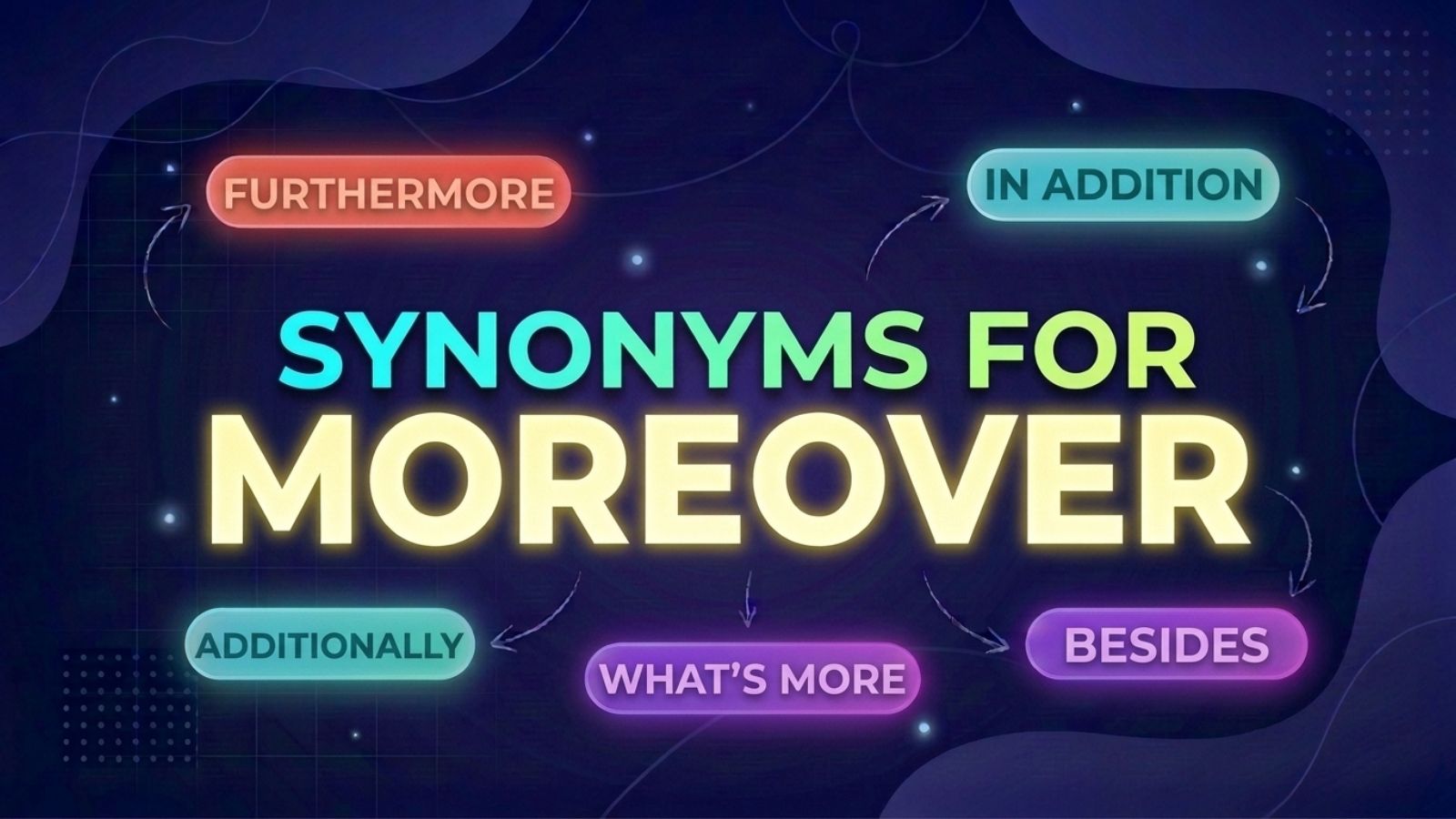
Looking for synonyms for moreover to make your writing clearer, more professional, and less repetitive? The word moreover is a formal transition word used to introduce additional information that supports or strengthens a previous statement. Depending on your sentence, alternatives such as furthermore, in addition, additionally, besides, and what’s more can help you connect ideas naturally.
However, these expressions are not always interchangeable. Some are best suited to academic essays and business reports, while others work better in everyday conversations. This guide explains the most useful alternatives to moreover, their meanings, example sentences, differences in tone, and how to choose the right transition for your writing.
What Does Moreover Mean?
Moreover is a conjunctive adverb that introduces additional information, often information that strengthens, supports, or adds weight to a previous statement.
In simple English, moreover means in addition to what has already been said.
For example:
- The proposal is affordable. Moreover, it can be implemented quickly.
- The student demonstrated excellent research skills. Moreover, her presentation was clear and persuasive.
- The building is centrally located. Moreover, it offers convenient access to public transportation.
In each example, the second sentence adds a point that supports the first.
Moreover is especially common in formal writing, including academic essays, research discussions, professional reports, and persuasive arguments. In casual conversation, also, plus, or what’s more may sound more natural.
Best Synonyms for Moreover
These are some of the most useful alternatives to moreover. The best choice depends on your intended meaning, sentence structure, and level of formality.
1. Furthermore
Meaning: In addition to what has already been stated, often adding another supporting point.
Furthermore is one of the closest synonyms for moreover and works well in academic and professional writing.
Example: The method is cost-effective. Furthermore, it produces reliable results.
2. In Addition
Meaning: Used to introduce another fact, reason, or point.
This phrase works in both formal and neutral writing.
Example: The course teaches grammar. In addition, it develops academic writing skills.
3. Additionally
Meaning: Used to introduce another item or piece of information.
Additionally is a useful alternative in reports, instructions, essays, and business communication.
Example: The software improves productivity. Additionally, it reduces manual errors.
4. Also
Meaning: Used to indicate that something is true or applies as well.
Also is shorter and more conversational than moreover, making it suitable for everyday writing.
Example: The restaurant serves vegetarian meals and also offers vegan options.
5. Besides
Meaning: Used to introduce another reason or point, sometimes with the sense of strengthening an argument.
Besides can sound more conversational than moreover and may introduce a persuasive or supplementary reason.
Example: We should leave early. Besides, traffic is usually heavy at this time.
6. What’s More
Meaning: Used to introduce an additional point that may be particularly interesting or persuasive.
This expression is less formal than moreover.
Example: The hotel is close to the beach. What’s more, breakfast is included.
7. As Well
Meaning: In addition; too.
As well is especially natural in everyday English and often appears at the end of a clause.
Example: The program helps beginners and supports experienced learners as well.
8. On Top of That
Meaning: In addition to what has already been mentioned.
This informal expression often emphasizes an extra advantage, problem, or burden.
Example: The bus was late, and on top of that, it started raining.
9. Plus
Meaning: In addition to something already mentioned.
Plus is useful in casual conversations, informal writing, and straightforward persuasive statements.
Example: The apartment is affordable, plus it is close to my workplace.
10. Not to Mention
Meaning: Used to introduce another relevant point, often one that strengthens the previous statement.
Example: The trip was expensive, not to mention exhausting.
Unlike moreover, not to mention often highlights an additional detail that the writer considers significant.
Formal Synonyms for Moreover
When writing an academic paper, business report, or formal email, choose transitions that maintain a professional tone.
| Synonym | Best use | Example |
|---|---|---|
| Furthermore | Adding supporting arguments | Furthermore, the findings support the original hypothesis. |
| Additionally | Introducing another point | Additionally, the report identifies several limitations. |
| In addition | Adding information clearly | In addition, the policy provides guidance for employees. |
| Further | Introducing an additional point in certain constructions | Further analysis is required to confirm the results. |
| Likewise | Adding a comparable point | Likewise, the second experiment produced consistent results. |
| Equally important | Highlighting another important consideration | Equally important, the policy protects employee privacy. |
| Beyond that | Moving to an additional consideration | Beyond that, the proposal requires further evaluation. |
| Coupled with this | Connecting one factor with another | Coupled with this, improved training may increase efficiency. |
Important: These expressions have different grammatical structures and meanings. Likewise introduces a similar point, while equally important emphasizes importance. Neither is a perfect substitute for moreover in every sentence.
Example: Improving an Academic Paragraph
Original:
The research identifies several factors that influence student performance. Moreover, it highlights the importance of effective feedback.
Revised:
The research identifies several factors that influence student performance. Furthermore, it highlights the importance of effective feedback.
Both versions are grammatically correct. Furthermore maintains the formal tone while adding another supporting point.
Synonyms for Moreover in Academic Writing
Academic writing benefits from clear transitions that show how ideas relate to one another. Although moreover is appropriate in essays, repeating it in every paragraph can make the writing sound mechanical.
Consider these alternatives:
- Furthermore: Adds another supporting argument.
- Additionally: Introduces another relevant fact.
- In addition: Connects supplementary information.
- Equally important: Emphasizes another significant consideration.
- Another consideration is: Introduces a new factor or perspective.
- It is also worth noting that: Draws attention to an additional point.
- Alongside this: Presents something that exists or operates in conjunction with another factor.
Examples:
- Furthermore, the findings suggest that regular practice improves retention.
- Additionally, the researchers identified several limitations in the sample.
- In addition, the study considers the effects of environmental factors.
- Equally important, the results demonstrate the need for further investigation.
- It is also worth noting that the participants came from different educational backgrounds.
Use transitions to express a genuine relationship between ideas, not simply to make the writing sound academic. A direct sentence without a transition can sometimes be clearer.
Synonyms for Moreover in Everyday English
In casual communication, simpler expressions usually sound more natural than formal linking words.
1. Also
Example: I enjoy reading. I also like writing short stories.
2. Plus
Example: The café has great coffee, plus the prices are reasonable.
3. And Another Thing
Example: The instructions were confusing. And another thing, the deadline was too short.
This phrase is conversational and may sound emphatic or slightly frustrated.
4. On Top of That
Example: I missed the train, and on top of that, my phone battery died.
5. What’s More
Example: The jacket is comfortable. What’s more, it is easy to wash.
6. Besides
Example: I do not want to go out tonight. Besides, I have homework to finish.
These expressions are useful in conversations, messages, blog posts, and informal essays. For formal academic writing, furthermore, additionally, and in addition are generally safer choices.
Synonyms for Moreover by Purpose
The most effective transition depends on the relationship between your ideas. Use this guide to select the most suitable expression.
| Purpose | Suitable expression | Example |
|---|---|---|
| Adding a supporting argument | Furthermore | Furthermore, the evidence supports the proposal. |
| Introducing another fact | Additionally | Additionally, the survey included younger participants. |
| Adding a simple point | Also | The service is reliable and also affordable. |
| Emphasizing importance | Equally important | Equally important, the policy improves accessibility. |
| Adding a persuasive reason | Besides | Besides, the alternative would cost more. |
| Highlighting an extra benefit | What’s more | What’s more, delivery is free. |
| Showing similarity | Likewise | Likewise, the second team achieved strong results. |
| Adding an informal observation | Plus | Plus, we have enough time to prepare. |
Notice that likewise is different from moreover. It generally signals similarity or correspondence, not just additional information.
Moreover vs. Furthermore vs. Additionally
These three expressions are closely related, but their emphasis can differ slightly.
| Word or phrase | Main function | Tone |
|---|---|---|
| Moreover | Adds information that often strengthens a previous point | Formal |
| Furthermore | Adds another supporting point or argument | Formal |
| Additionally | Introduces extra information, often in a neutral way | Formal or neutral |
For example:
- The proposal is practical. Moreover, it addresses the main concerns.
- The proposal is practical. Furthermore, it addresses the main concerns.
- The proposal is practical. Additionally, it includes a detailed implementation plan.
The first two sentences are particularly similar in function. The third emphasizes the addition of another piece of information. In many contexts, however, all three can work naturally.
How to Use Moreover and Its Synonyms Correctly
Because moreover is a conjunctive adverb, punctuation matters when it connects independent clauses.
1. Use a Period Between Complete Sentences
Correct:
The product is affordable. Moreover, it is durable.
Each sentence is complete, and moreover introduces additional information.
2. Use a Semicolon When Connecting Independent Clauses
Correct:
The product is affordable; moreover, it is durable.
A semicolon can connect two closely related independent clauses, with moreover introducing the second.
3. Avoid Joining Independent Clauses With Only a Comma
Incorrect:
The product is affordable, moreover, it is durable.
Correct:
The product is affordable; moreover, it is durable.
The incorrect version creates a comma splice because two independent clauses are joined without suitable punctuation.
4. Choose a Transition That Matches Your Meaning
Not every transition means the same thing.
- Use moreover to add a supporting point.
- Use however to introduce contrast.
- Use therefore to introduce a result or conclusion.
- Use likewise to show similarity.
- Use for example to introduce an illustration.
Selecting the right transition makes the logical relationship between sentences easier to understand.
Common Mistakes When Replacing Moreover
Mistake 1: Using “However” as a Synonym
However signals contrast, while moreover adds information.
Incorrect for addition: The plan is affordable. However, it is easy to implement.
Better: The plan is affordable. Moreover, it is easy to implement.
The first version suggests a contrast that the sentence does not establish.
Mistake 2: Using “Therefore” to Add Information
Therefore generally introduces a result or conclusion.
Incorrect for simple addition: The evidence is strong. Therefore, the report includes another example.
Better: The evidence is strong. Furthermore, the report includes another example.
Use therefore when the second statement follows logically as a consequence of the first.
Mistake 3: Repeating the Same Transition Too Often
Repeatedly beginning paragraphs with moreover can make an essay monotonous.
Instead, use a variety of appropriate transitions, such as furthermore, in addition, also, or equally important. You can also connect ideas directly without a transition when their relationship is already clear.
Mistake 4: Choosing an Informal Expression for a Formal Essay
Expressions such as plus and on top of that may sound too conversational in a research paper.
For formal writing, prefer furthermore, additionally, or in addition when they accurately express the intended relationship.
Frequently Asked Questions
1. What are the best synonyms for moreover?
The best synonyms for moreover include furthermore, in addition, additionally, also, besides, and what’s more. Furthermore is particularly close in meaning and works well in academic and professional writing.
2. What is a formal word for moreover?
Furthermore and additionally are excellent formal alternatives. In addition is another clear option for academic essays, reports, and professional documents.
3. Can I use “also” instead of “moreover”?
Yes. Also can replace moreover when you simply want to add information. However, also is generally more neutral and conversational, while moreover often emphasizes the importance of an additional argument.
4. Is moreover suitable for academic writing?
Yes. Moreover is appropriate for academic writing when introducing an additional point that supports or strengthens the previous statement. Use it naturally rather than repeating it in every paragraph.
5. What is the difference between moreover and however?
Moreover adds information that supports or extends a previous point. However introduces contrast or an opposing consideration.
Example: The method is affordable. Moreover, it is efficient.
Example: The method is affordable. However, it takes considerable time.
6. What can I use instead of moreover in an essay?
For an essay, consider furthermore, additionally, in addition, or equally important. Choose the transition that best reflects the relationship between your arguments and maintains the tone of your writing.
Conclusion
The best synonyms for moreover include furthermore, additionally, in addition, also, and what’s more. For academic essays and professional reports, formal alternatives such as furthermore and additionally are particularly useful. In everyday communication, also, plus, and besides may sound more natural.
The key is to choose a transition that matches your meaning, tone, and sentence structure. By using these expressions carefully, you can connect ideas smoothly, avoid unnecessary repetition, and make your writing clearer and more engaging.