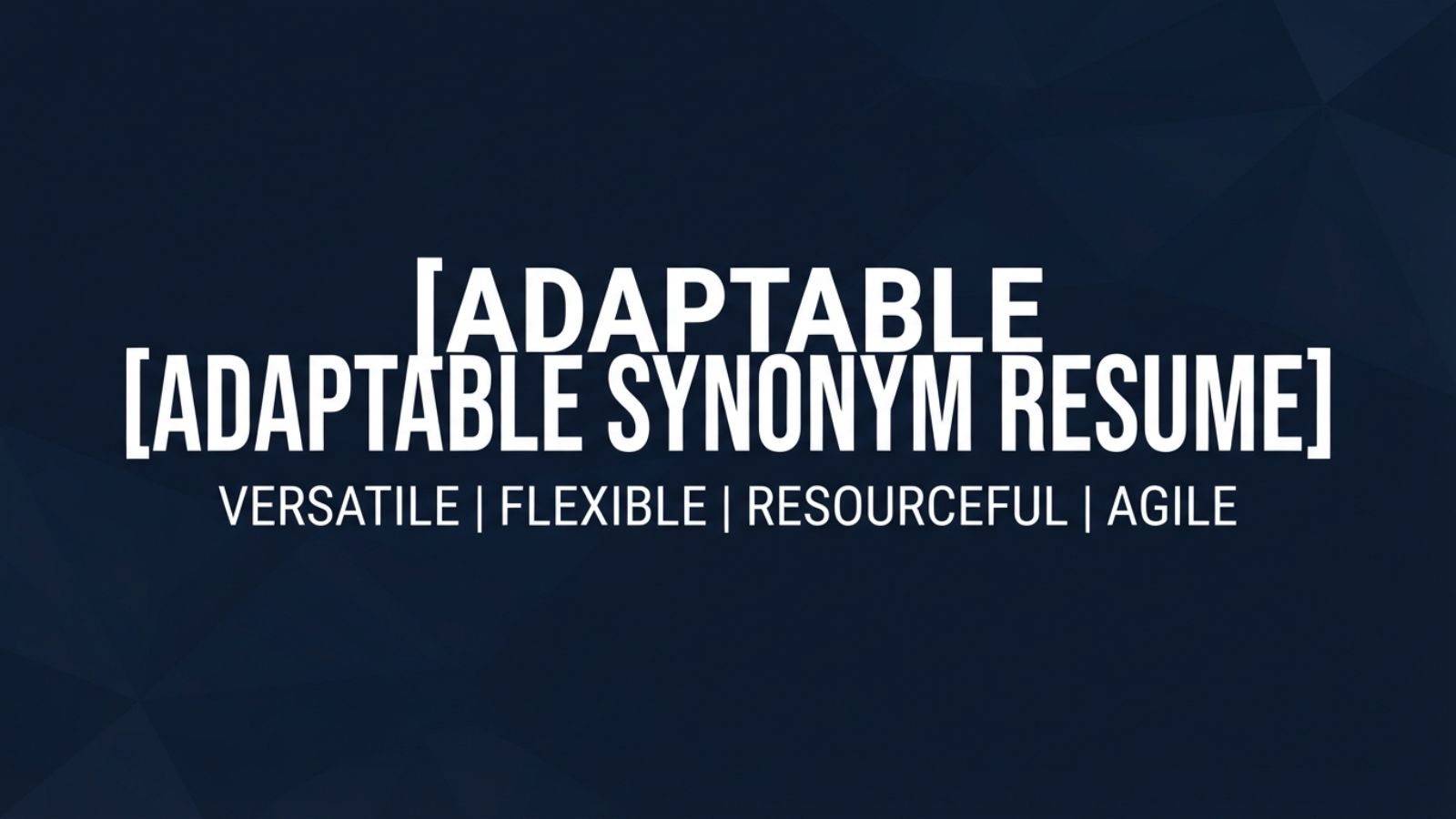
If you are searching for an adaptable synonym resume phrase, you probably want a stronger, more professional way to show that you handle change well. While adaptable is accurate, simply listing it as a soft skill can sound vague. Better alternatives include versatile, flexible, resourceful, agile, resilient, responsive, and open-minded—but each communicates a slightly different quality. The best choice depends on whether you want to emphasize learning quickly, handling varied responsibilities, solving unexpected problems, or adjusting to changing priorities. Most importantly, your resume should demonstrate adaptability through specific achievements, rather than relying only on an adjective.
What Does “Adaptable” Mean on a Resume?
Adaptable is an adjective describing someone who can adjust effectively to new conditions, responsibilities, environments, or requirements. Cambridge Dictionary defines it as being able or willing to change to suit different conditions.
On a resume, adaptability can refer to your ability to:
- Learn new tools or processes quickly
- Adjust when priorities change
- Take on different responsibilities
- Work effectively with different teams
- Respond to unexpected problems
- Change strategies when circumstances require it
- Continue performing during organizational or operational changes
For example:
Adaptable marketing professional who quickly adjusted campaign strategies to changing customer needs.
The sentence communicates flexibility, but it becomes more convincing when supported by a specific result.
Best Adaptable Synonyms for a Resume
Not every synonym for adaptable means exactly the same thing. Choose a word according to the specific strength you want your resume to communicate.
1. Versatile
Meaning: Able to perform effectively across different roles, tasks, skills, or situations.
Example:
Versatile professional with experience across customer service, administration, and sales.
Best for: Candidates with broad responsibilities or cross-functional experience.
2. Flexible
Meaning: Able to adjust to changing requirements, schedules, priorities, or circumstances.
Example:
Flexible team member who regularly adjusted priorities to meet changing client requirements.
Best for: Workplace flexibility and changing responsibilities.
3. Resourceful
Meaning: Skilled at finding practical solutions when resources, information, or circumstances are limited.
Example:
Resourceful coordinator who resolved unexpected scheduling issues without disrupting operations.
Best for: Problem-solving and independent thinking.
4. Agile
Meaning: Able to respond quickly and effectively to changing information or conditions.
Example:
Agile project coordinator who adjusted workflows as project requirements evolved.
Best for: Technology, project management, product, marketing, and fast-moving environments.
5. Resilient
Meaning: Able to recover from difficulties and continue functioning effectively.
Example:
Resilient customer-support professional who maintained service quality during periods of high demand.
Best for: Demonstrating composure and persistence during challenges.
6. Responsive
Meaning: Quick and appropriate in reacting to needs, changes, requests, or problems.
Example:
Responsive account representative who adapted solutions to changing client requirements.
Best for: Customer service, account management, operations, and communication.
7. Open-Minded
Meaning: Willing to consider new ideas, approaches, feedback, or perspectives.
Example:
Open-minded team member who incorporated feedback to improve project workflows.
Best for: Collaboration, learning, and roles involving continuous improvement.
8. Receptive
Meaning: Willing to accept and consider suggestions, feedback, or new information.
Example:
Receptive to feedback and quick to implement revised quality-control procedures.
Best for: Learning, teamwork, training, and professional development.
9. Multiskilled
Meaning: Having competence in several different areas or types of work.
Example:
Multiskilled operations assistant supporting inventory, scheduling, and customer service.
Best for: Candidates whose adaptability comes from having several practical skills.
10. Well-Rounded
Meaning: Having experience or abilities across several relevant areas.
Example:
Well-rounded administrative professional with experience in scheduling, reporting, and client support.
Best for: Entry-level and mid-career resumes.
11. Dynamic
Meaning: Energetic and capable of functioning effectively in changing circumstances.
Example:
Dynamic sales professional experienced in adapting outreach strategies to changing markets.
Best for: Sales, marketing, leadership, and fast-paced workplaces.
12. Innovative
Meaning: Able to introduce new ideas, approaches, or solutions.
Example:
Innovative problem-solver who redesigned an inefficient reporting process.
Best for: Showing that you respond to change by creating better solutions.
13. Proactive
Meaning: Taking action before problems or needs require an immediate response.
Example:
Proactive coordinator who anticipated workflow changes and updated procedures accordingly.
Best for: Showing initiative rather than simply reacting to change.
14. Receptive to Change
Meaning: Willing to accept and work effectively with new methods, systems, or circumstances.
Example:
Receptive to change and quick to adopt updated customer-service procedures.
Best for: Resumes where workplace transformation is important.
15. Change-Ready
Meaning: Prepared to respond constructively when circumstances or requirements change.
Example:
Change-ready professional experienced in supporting teams through process improvements.
Best for: Change-management contexts, though it is generally less established than “adaptable.”
16. Quick-Learning
Meaning: Able to understand and acquire new knowledge or skills rapidly.
Example:
Quick-learning assistant who mastered a new CRM system within the first month.
Best for: Entry-level applicants, career changers, and technology-heavy roles.
17. Learner-Focused
Meaning: Strongly committed to acquiring new knowledge and improving skills.
Example:
Learner-focused professional who completed new software training to support expanded team responsibilities.
Best for: Professional-development contexts.
18. Versed
Meaning: Knowledgeable or experienced in a particular subject, system, or area.
Example:
Versed in multiple customer relationship management platforms and reporting tools.
Best for: Showing breadth of knowledge rather than general personality.
19. Accommodating
Meaning: Willing and able to adjust reasonably to the needs of others or changing circumstances.
Example:
Accommodating service professional who adjusted support processes to meet diverse client needs.
Best for: Customer-facing and service-oriented roles.
20. Flexible-Minded
Meaning: Willing to consider different approaches and adjust one’s thinking.
Example:
Flexible-minded team member who evaluated alternative approaches to improve project delivery.
Best for: Collaboration and problem-solving, although “open-minded” is usually more natural.
Adaptable Synonyms by Resume Context
The strongest word depends on what kind of adaptability you actually want to show.
| What You Want to Show | Better Resume Word | Why It Fits |
|---|---|---|
| Different responsibilities | Versatile | Highlights range |
| Changing priorities | Flexible | Emphasizes adjustment |
| Unexpected problems | Resourceful | Highlights solutions |
| Rapid changes | Agile | Emphasizes quick response |
| Difficult circumstances | Resilient | Shows recovery and persistence |
| New ideas | Open-minded | Shows receptiveness |
| Fast learning | Quick-learning | Highlights learning speed |
| New solutions | Innovative | Shows creative adaptation |
| Customer needs | Responsive | Emphasizes timely reactions |
| Multiple skills | Multiskilled | Demonstrates breadth |
These distinctions matter because dictionaries and career resources treat words such as flexible, versatile, resilient, and adaptable as related but not completely interchangeable.
The Best Way to Show Adaptability on a Resume
Simply writing “adaptable” in a skills section is rarely as persuasive as demonstrating the quality through your experience.
Compare these two statements:
Weak:
Adaptable and hardworking employee.
Stronger:
Transitioned to a new customer-management system within four weeks and trained three colleagues on the updated workflow.
The second example gives the reader evidence. It shows a change, your response, and an outcome.
Career guidance similarly recommends using action-oriented experience statements to demonstrate flexibility and adaptability rather than relying entirely on soft-skill labels.
Use Adaptability Action Verbs
Instead of repeatedly writing “adaptable,” consider verbs that show what you actually did:
- Adapted
- Adjusted
- Pivoted
- Transitioned
- Modified
- Updated
- Revamped
- Integrated
- Restructured
- Responded
- Reorganized
- Learned
- Implemented
- Resolved
- Transformed
For example:
Adjusted the project schedule after requirements changed, keeping all major deliverables on track.
This is stronger than:
Adaptable employee who handles changing deadlines.
How to Choose the Right Synonym
Before replacing adaptable, identify the exact ability behind the word.
If you handle many different responsibilities, choose versatile.
If you regularly adjust schedules or priorities, flexible may be more accurate.
If you solve unexpected problems with limited resources, choose resourceful.
If you learn new systems rapidly, quick-learning or a specific achievement may work better.
If you remain effective through setbacks, resilient communicates that quality more precisely.
If you respond rapidly to new information, agile may be appropriate.
This approach prevents a common resume problem: using impressive-sounding words that do not accurately describe your experience.
Adaptable Resume Examples
Here are several natural ways to demonstrate adaptability without repeating the same adjective.
Career changer:
Transitioned from retail operations to digital customer support after completing intensive CRM and communication training.
Technology role:
Learned a new project-management platform and redesigned team workflows to improve task visibility.
Customer service:
Adjusted communication strategies to accommodate changing customer needs while maintaining service standards.
Project management:
Pivoted project priorities after stakeholder requirements changed, keeping key milestones on schedule.
Administrative role:
Supported scheduling, reporting, and client coordination during a period of increased departmental workload.
Marketing:
Modified campaign messaging in response to performance data and improved engagement across targeted channels.
Notice that these examples do not simply claim adaptability. They show a situation that required adjustment and explain what the candidate did.
Adaptable vs. Flexible vs. Versatile
These three words are close, but they are not always interchangeable.
Adaptable is the broadest choice when someone can adjust to new conditions.
Flexible commonly emphasizes willingness or ability to change plans, responsibilities, schedules, or approaches.
Versatile focuses more strongly on being capable across different tasks, roles, skills, or environments.
For example:
Adaptable: Adjusted effectively when project requirements changed.
Flexible: Took on changing shifts and responsibilities to support team needs.
Versatile: Managed design, content, and basic analytics across multiple campaigns.
Choosing the most precise word makes your resume sound more credible than repeatedly using generic soft-skill adjectives.
Is “Adaptable” a Good Word for a Resume?
Yes, adaptable is a legitimate and useful resume word, especially when the job description emphasizes flexibility or responding to change. However, it is more effective when supported by evidence.
Instead of writing:
Adaptable professional with excellent teamwork skills.
Try:
Adapted quickly to a new workflow, learning unfamiliar software and supporting the team during implementation.
The second version gives the employer something concrete to evaluate. Current career guidance also emphasizes that adaptability is best demonstrated through examples involving new tools, changing processes, shifting priorities, and unexpected challenges.
Common Mistakes When Using Adaptable Synonyms
Using a synonym without checking its meaning
Resilient does not simply mean “good at learning new software.” It relates more closely to recovering or continuing effectively through difficulty.
Using overly broad adjectives
Words such as “dynamic” or “versatile” can sound vague if no experience supports them.
Repeating the same synonym
Replacing “adaptable” with “flexible” in every resume bullet does not improve the writing. Vary your language according to the actual situation.
Choosing a word only because it sounds impressive
Accuracy matters more than sophistication. Resourceful is useful when you solved problems creatively; it should not replace “adaptable” automatically.
Listing adaptability without evidence
A recruiter can understand “adaptable,” but a specific achievement gives the claim much more credibility.
Frequently Asked Questions
What is the best synonym for adaptable on a resume?
Versatile, flexible, resourceful, agile, and responsive are among the strongest choices, but the best option depends on the situation. Use versatile for varied responsibilities, resourceful for problem-solving, and agile for rapid change.
What is a professional word for adaptable?
Versatile is a strong professional alternative when you can work effectively across different responsibilities. Resourceful, agile, and responsive can be more precise in specific contexts.
How can I say I am adaptable without using the word?
Describe a situation where you adjusted successfully. For example, explain how you learned a new system, changed a project strategy, took on new responsibilities, or solved an unexpected problem.
Is flexible better than adaptable on a resume?
Not necessarily. Flexible usually emphasizes willingness or ability to adjust, while adaptable more broadly describes adjusting to new conditions. Choose whichever accurately describes your experience.
Is versatile the same as adaptable?
They overlap but are not identical. Versatile emphasizes the ability to handle different tasks, roles, or skills, while adaptable emphasizes adjusting effectively to changing conditions.
Should I put adaptable in my resume skills section?
You can, particularly when it matches the job description, but evidence in your experience section is stronger. Show adaptability through specific actions, changes you handled, and measurable results whenever possible.
Final Thoughts
The best adaptable synonym resume choice is not necessarily the most sophisticated word. It is the word that precisely describes how you respond to change. Versatile works well for varied responsibilities, resourceful for unexpected problems, agile for rapid change, resilient for difficult circumstances, and flexible for changing priorities. Most importantly, demonstrate the quality through real accomplishments. A resume that shows how you adjusted, learned, solved problems, or changed direction will usually communicate adaptability more effectively than a simple list of personality traits.